
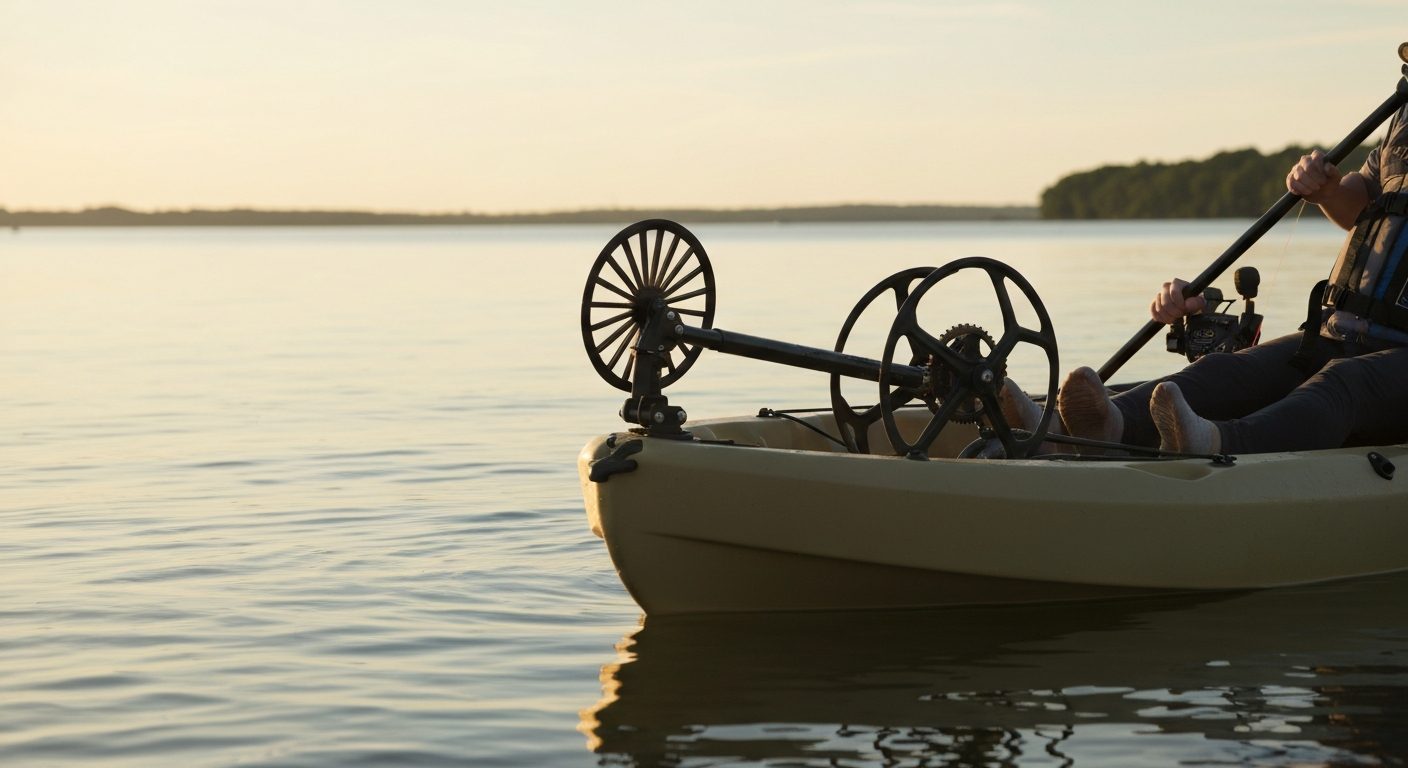
Fin Drive vs Prop Drive Pedal Kayaks
Pedal kayak drives split into two camps — fin (flipper) and prop (propeller) — and choosing the wrong one for your water can cost you a fishing trip.
Best pedal kayaksWe’ve put both systems through their paces on weedy backwaters and open reservoirs, and the honest answer is neither one is universally better. The right choice depends entirely on where you fish.
How a fin (flipper) drive works
A fin drive — most famously Hobie’s MirageDrive — uses two wing-shaped fins that oscillate back and forth under the hull, mimicking the motion of a penguin’s flippers. Each pedal stroke pushes one fin forward while the other sweeps back, generating thrust on both the push and the pull. There’s no rotational mechanism, no spinning parts below the waterline.
What that means in practice: fins flex upward when they hit an obstacle. Rocks, logs, hydrilla mats — the fins deflect rather than jam. That passive flex-and-recover behavior is why fin drives dominate in shallow, vegetation-heavy water. You can cruise through knee-deep grass that would wrap around a prop in seconds.
The tradeoff? Most fin-drive kayaks don’t have reverse built into the standard drive unit. Hobie’s 180 upgrade adds it, but the base MirageDrive is forward-only. You steer with a rudder, not by changing drive direction. In tight quarters you’re backing up with a paddle or spinning the boat.
Fin drives are also generally quieter at low speeds — another plus for stalking shallow fish.
How a prop (propeller) drive works
A prop drive uses one or two small propellers — think Native Watercraft’s Propel or Perception’s Pilot — that spin continuously as you pedal. The pedal mechanism turns a driveshaft, which turns the prop. Simple, efficient, and fast.
The biggest functional advantage: true, hands-free reverse. Backpedal and the prop spins the other way. You can pull away from a dock, back out of a cove, or reposition on a drift without ever touching a paddle. For open-water anglers who spend most of their time on lakes, reservoirs, and bays, that reverse gear is genuinely useful every single trip.
Prop drives also tend to deliver slightly higher top-end speeds in open water because the spinning prop converts pedal force efficiently at higher RPMs.
The weakness is vegetation. A prop will wrap grass, monofilament, or hydrilla in seconds. Most prop-drive systems let you pop the drive out quickly to clear it, but if you fish weedy shallows regularly, you will be doing that constantly. Shallow muck is also harder on a prop — there’s less clearance forgiveness than with fins that flex up and away.
According to the American Canoe Association, understanding your local water type is the single most important factor in choosing any kayak drive system — and prop vs. fin is exactly where that principle shows up most clearly.
Fin vs prop: which wins where
Here’s how the two systems stack up across the conditions that matter most to kayak anglers:
| Condition | Fin Drive | Prop Drive |
|---|---|---|
| Shallow grass flats | ✓ Wins — fins flex over weeds | ✗ Prop fouls quickly |
| Open lake / reservoir | Solid | ✓ Wins — faster, true reverse |
| Rocky shallows | ✓ Fins deflect off rocks | Risky — prop can strike |
| Tidal flats / marshes | ✓ Wins — low draft, flexible | Manageable if water is clear |
| Reverse / repositioning | ✗ Forward-only (base units) | ✓ Wins — backpedal reverses |
| Top-end speed | Comparable | ✓ Slight edge in open water |
| Weed clearing | ✓ Self-clearing most of the time | Manual pop-out required |
If you fish two or more of these environments regularly, map where you spend the most time. The answer usually reveals itself fast.
Which should you buy?
Start by being honest about where you actually fish — not where you think you might fish someday. If 80% of your trips are on a weedy bass lake or a tidal flat, a fin drive is the safer default. If you’re mostly open-water walleye or saltwater bay fishing, a prop drive’s reverse and speed advantage will matter every outing.
Budget is also real. Fin-drive kayaks (especially Hobie) tend to carry a price premium. Prop-drive options from Native Watercraft and Perception often deliver comparable performance at a lower entry point. We cover the best options in our best pedal kayak roundup and walk through the value question in detail in are pedal kayaks worth it.
If you’re coming from a paddle kayak and wondering whether to make the switch at all, our pedal vs paddle fishing kayak comparison covers that ground.
A few practical tips before you buy:
- Demo if you can. Most drive systems feel different underfoot. What pedals smoothly for one angler can feel awkward for another.
- Check drive compatibility. Some kayak brands only accept their proprietary drive; others accept third-party systems. Don’t assume.
- Factor in maintenance. Prop drives need periodic inspection of the driveshaft seal. Fin drives need the fin tracks cleaned and occasionally re-greased. Neither is high-maintenance, but both need some.
- Think about transport. Drives pop out on most modern kayaks, but fin sizes vary — make sure yours fits your vehicle setup and storage space.
Either system will outfish a paddle kayak for anglers who cover water or need hands-free trolling. The fin-vs-prop decision is the fine-tuning layer on top of that already excellent foundation.
Frequently Asked Questions
Which is better for shallow water — fin drive or prop drive?
Fin drive wins in shallow water. The fins flex upward when they contact weeds, rocks, or bottom muck, which means they self-clear and don’t jam. A prop will wrap vegetation in seconds in shallow grass or hydrilla. If you fish flats, marshes, or weedy lakes, a fin drive is the practical choice every time.
Does a fin drive kayak go in reverse?
Most base fin-drive systems don’t include reverse — they’re forward-only and you steer with a rudder. Hobie offers a 180 upgrade kit that adds reverse capability to the MirageDrive, but it costs extra. Prop drives, by contrast, reverse simply by backpedaling, making them naturally more maneuverable in tight spots without any add-on.
Is Hobie a fin drive or prop drive?
Hobie uses a fin (flipper) drive called the MirageDrive. It’s the most well-known fin system on the market and has been refined over decades. The fins oscillate back and forth rather than spinning, which is why Hobie kayaks perform so well in weeds and shallows. Native Watercraft and Perception are the most recognized prop-drive brands.
Which pedal drive system is faster — fin or prop?
In open water, prop drives have a slight top-end speed advantage because a spinning propeller converts pedal force efficiently at higher RPMs. In real fishing conditions the difference is modest — we’re talking fractions of a mile per hour. For most anglers, the choice between fin and prop should be driven by water type and reverse capability, not raw speed.