
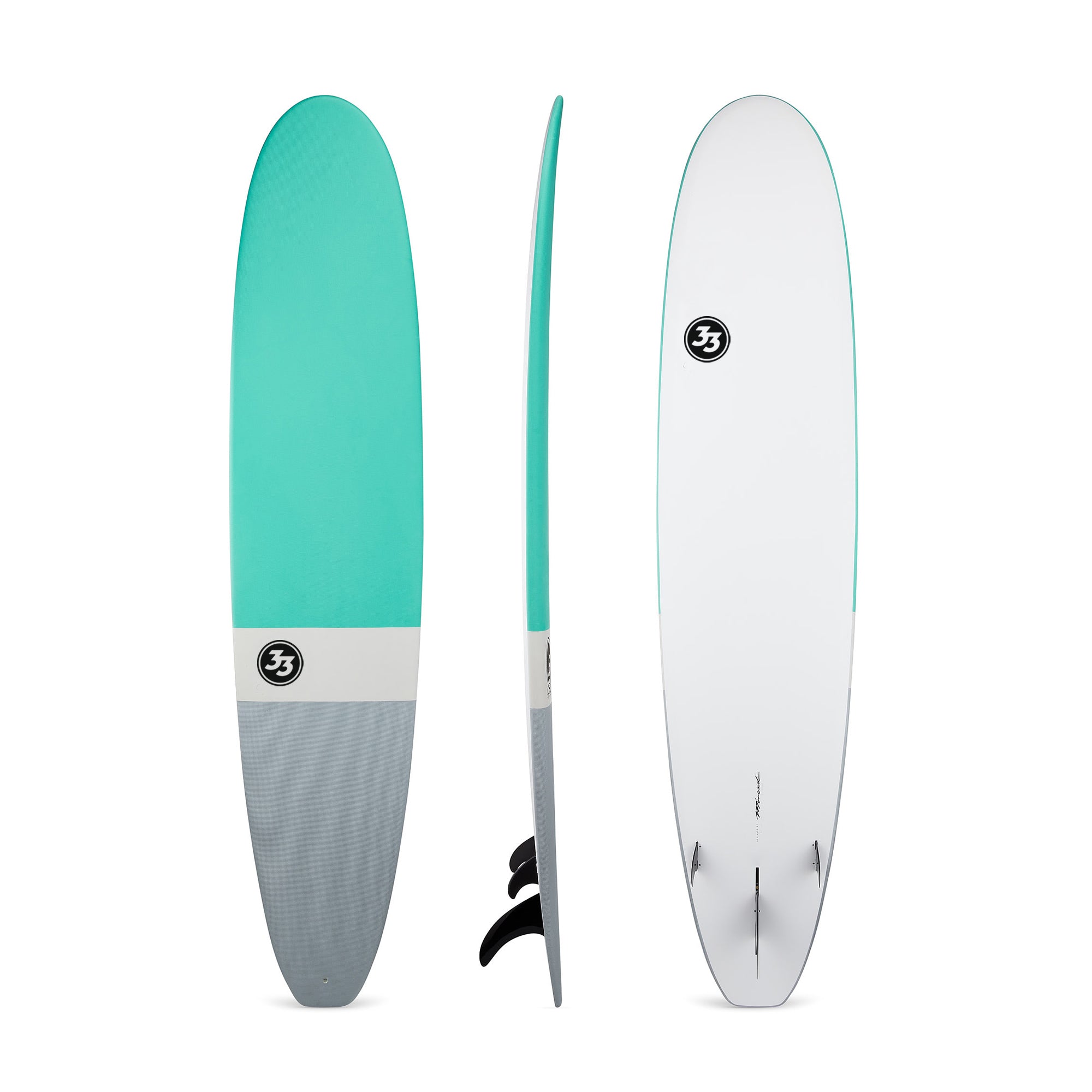
Degree33 Ultimate Longboard Soft-Top Review
The Degree33 Ultimate Longboard is the rare soft-top that actually surfs like a real board — it paddles well, turns when you push it, and grows with you as you improve. At around $600 it costs more than a basic foamie, but you get a board worth keeping.
Most soft-tops hand you a spongy plank that keeps you safe while you figure out which way is forward. The Degree33 Ultimate Longboard takes a different approach: it starts with a genuine performance longboard shape, wraps it in a soft EVA deck, and adds an EPS core with wood stringers to keep it lively underfoot. The result is a board that beginners can ride comfortably and intermediates can actually surf.
We spent several sessions on the Ultimate across waist-high beach break and slower point-break walls. Our crew ranged from a first-year surfer who wanted something forgiving to a three-year intermediate looking to cross-step and hang five on a foamie. Both walked away impressed, though for different reasons.
If you’ve been browsing the best soft-top surfboards and keep landing on the Degree33, this review will tell you exactly what you’re getting — and what you’re giving up at this price.
Degree33 Ultimate Longboard specs
| Length | 8′-9′ |
| Type | Performance soft-top |
| Core | EPS / wood stringers |
| Rider | Beginner-intermediate |
| Skill | Improver |
| Best for | Performance foamie |
On the water — a foamie that performs
Paddle-out is easy. The Ultimate catches waves earlier than most boards its size because the EPS core floats high and the full nose template gives you plenty of planning surface. We were on waves that most 9-foot foamies struggle to catch cleanly, and the Ultimate was gliding into them without a fight.
Once you’re up, the difference from a cheap foam board is immediate. The wood stringers run the full length of the deck, and you can feel them: there’s a spine under your feet rather than the mushy flex you get on a budget soft-top. The board holds its rail through a turn instead of washing sideways. We managed actual bottom turns, not just direction changes, and the nose ride section of a long wall gave us a genuine cross-step opportunity rather than a nose that just pearled when we shifted weight forward.
Wipeouts are what you’d expect from any quality soft-top: low consequence. The deck absorbs impact, the rails are forgiving, and the leash attachment is solid. Nothing surprising here — it does the safety job well while still letting you surf with intention.
Construction & shape
The core is EPS foam, the same expanded polystyrene used in high-performance epoxy boards. It’s lighter and more responsive than the polyurethane blanks inside traditional longboards, and it makes the Ultimate buoyant without feeling waterlogged. The full-length wood stringers — typically two of them — add torsional stiffness so the board doesn’t twist under you mid-turn.
The deck is a standard soft EVA foam skin, textured for grip. You don’t need wax, which is a genuine convenience for beginners and a small quality-of-life win for anyone who’s ever stepped on a cold, waxless board at dawn. The bottom is a hard HDPE slick, which slides cleanly and holds up to beach drag without cracking.
Shape-wise, Degree33 uses a genuine longboard template: a rounded nose with enough width to carry volume into the tip, moderate concave through the mid-section, and a rounded pin or squash tail depending on the size you pick. The rocker is low enough to paddle well in small surf but not so flat that the nose catches in steeper waves. Fins are a classic 2+1 setup — a larger center fin with two side bites — which gives you options from nose-riding looseness to a more pivoty thruster-style feel depending on how you set them.
Available lengths typically run 8′ to 9’6″. The 8’6″ hits the sweet spot for most adult beginners and lighter intermediates. Heavier riders or anyone who wants maximum glide should size up to 9′ or 9’6″.
Beginner to improver — growing into it
Most beginner boards are disposable. You ride them for a season, outgrow them, and move on. The Ultimate is designed to last past that first season, and it does. Here’s why it works for both ends of the learning curve.
For beginners, the soft deck and extra volume mean fewer bruises and easier pop-ups. The paddle power is forgiving of sloppy technique — you’ll catch waves even when your timing is slightly off. The wide stable platform lets you find your feet without the board squirting out from under you every other wave. And the fins are set up so the board tracks straight when you want it to and responds when you push harder.
For improvers, the performance shape starts to reward better technique. You can actually drive off the back foot through a bottom turn. The board responds to rail pressure. You can work toward hanging five on a longer section without the nose nose-diving immediately. These are things a Wavestorm or a basic department-store foam board simply cannot do.
The upgrade path is also sensible. You don’t outgrow the Ultimate quickly because the shape has enough ceiling to keep challenging you. When you do eventually move to a glassed board — and most surfers do — the muscle memory you’ve built on the Ultimate transfers cleanly. You haven’t been practicing on a toy. Check out our guide to the best longboard surfboards when you’re ready to make that jump.
Who it's for (and who should skip it)
The Degree33 Ultimate Longboard makes sense if you’re a beginner who wants one board that lasts more than a season, an improver who surfs soft-top for safety or convenience and doesn’t want to sacrifice performance, a parent buying a board a kid can actually grow into, or someone who just wants a genuinely fun longboard session without waxing up a glassed board. It also travels well — no ding anxiety, no fragile glass to crack in an overhead.
Skip it if you’re on a tight budget. At around $600, the Ultimate costs two to three times what you’d pay for a basic foam board, and if you’re not sure surfing will stick, that’s a real consideration. A cheaper soft-top will teach you the same fundamentals for a fraction of the price.
Also skip it if you’re an advanced surfer looking for a noserider or a high-performance log. The Ultimate is a great hybrid, but dedicated nose-riding or serious longboard performance still belongs on a glassed board with a proper single-fin setup. For a broader look at your options, see our roundup of the best surfboards across all skill levels.
One more thing worth knowing: Degree33 sells direct, which keeps the price honest and means you’re not paying a retail markup. Customer service has been responsive in our experience, and the warranty covers manufacturer defects. For more on soft-top safety and surf education, Surfrider Foundation is a solid resource for new surfers getting oriented in the ocean.
What we liked
- Genuine performance shape — turns, cross-steps, and responds to rail pressure like a real longboard
- EPS core with wood stringers gives it stiffness and lifespan beyond basic foam boards
- Beginner-safe soft deck with zero wax needed and forgiving wipeouts
- Long learning ceiling — stays relevant as you improve rather than becoming a yard-sale board
- Sold direct by Degree33 with no retail markup and responsive customer service
- 2+1 fin setup gives you flexibility to tune the feel from loose to stable
The catches
- At around $600, it's significantly more expensive than basic foamies like the Wavestorm
- Not a dedicated noserider — advanced longboarders will eventually want a proper glassed single-fin
- Heavier than a glassed board of comparable size, which shows on longer paddle-outs