
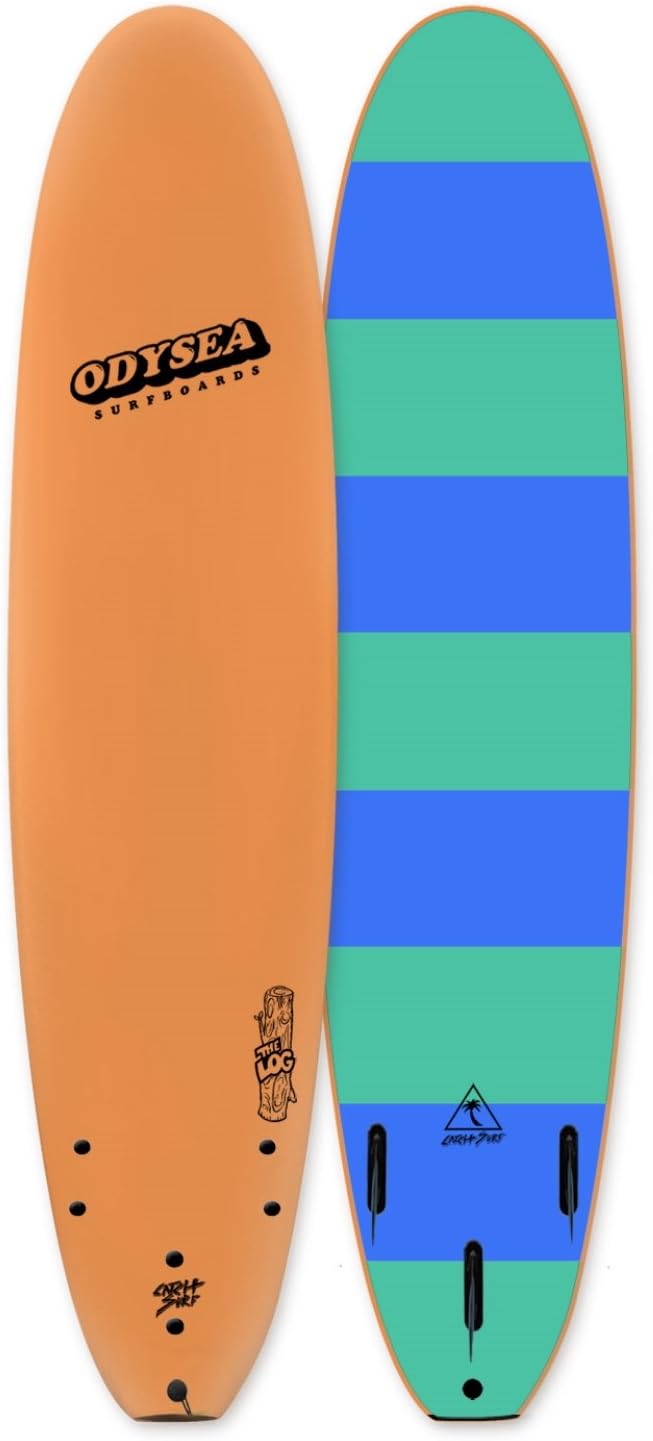
Catch Surf Odysea Log 8' Review
The Odysea Log is the foamie that actually surfs — stiffer, more responsive, and more versatile than budget soft-tops, it's the right move for beginners ready to graduate and intermediates who want a playful longboard feel without beating up a glassed board.
We’ve ridden a lot of foam surfboards. Most of them are fine for their job — they catch waves, they don’t hurt when they hit you, and they don’t cost much. The Catch Surf Odysea Log 8′ is something different. It’s a foamie that actually has opinions. It wants to trim, it wants to nose-ride, and it holds a line instead of washing all over the place. That matters when you’re trying to get better, not just get wet.
At around $330, it’s roughly twice the price of a Wavestorm. That’s a real gap, and we’re going to tell you whether it’s worth it. Short version: for the right surfer, it is. For someone who’s still figuring out how to pop up, probably not yet. Our beginner surfboard guide breaks down that decision in more detail if you’re still in that camp.
We put this board through its paces in small-to-medium beach break and point surf, riding it across a range of wave conditions. Here’s what we found.
Catch Surf Odysea Log 8' specs
| Length | 8′ |
| Type | Foam log |
| Fins | Tri-quad |
| Stringers | 3 (stiffer) |
| Skill | Beginner-intermediate |
| Best for | Wave-catching step-up |
On the water — performance vs a basic foamie
The first thing you notice paddling the Odysea Log is how well it glides. The 8′ length and high-volume foam hull catches waves early — you’re up and riding while other people are still paddling. That’s not a surprise for a board this size. What is a surprise is what happens after you’re on the wave.
Where a Wavestorm tends to go where the wave sends it, the Odysea Log goes where you point it. There’s real drive off the tail, and because the three high-density stringers stiffen the deck significantly, there’s almost no flex through your turns. That stiffness translates directly into energy — the board actually snaps back and pushes you through your next move rather than just absorbing it.
On small, mushy waves — the kind that dominate most sessions — the high volume keeps you planing and gives you options to pick your line early. On steeper, faster surf the board handles it without getting squirrelly. It’s not a performance shortboard, but it’s not trying to be. As a longboard-style foamie it does exactly what it’s supposed to, and it does it better than most. If you want to compare it to other soft-top options, our soft-top surfboard roundup puts it in context alongside the full field.
Construction & fin setup
Catch Surf builds the Odysea Log with a high-density foam core and three full-length stringers running nose to tail. Most budget foamies use a single stringer or none at all. Three stringers change the physics — the board resists torsional flex, which means your rail-to-rail transitions actually do something instead of just twisting the deck.
The deck itself uses a softer foam skin that’s forgiving on wipeouts and easy on your knees during pop-ups. The bottom is a slicker, harder material that lets the board release cleanly and pick up speed. The construction is noticeably more refined than entry-level foam boards — seams are clean, the fin boxes are properly glassed in, and the tail block doesn’t feel like it’s going to separate after a dozen sessions.
The fin setup is one of the board’s best features: five fin boxes in a tri-quad configuration. That means you can run it as a thruster (three fins), a twin-plus-trailer, or a quad (four fins). Each setup changes the way the board feels. Thruster is the most balanced and forgiving — a good starting point. Quad gives you more drive and speed down the line with a looser feel. It’s genuinely useful versatility rather than a marketing checkbox. Fins are included in the box. For more on how different fin setups affect performance, Wikipedia’s surfboard fin overview is a solid primer.
Who should step up to this
The Odysea Log is a step-up foamie. That phrase gets thrown around loosely, so let’s be specific about what it means here. This board is for surfers who can already pop up reliably and ride the wave on their own terms — not just survive it. If you’re still working on getting to your feet consistently, a cheaper, more forgiving beginner board will serve you better while you build that muscle memory.
Once you’re past that stage, the Odysea Log gives you room to grow. The stiffness rewards proper weight distribution. The fin options let you experiment with how fin choice changes your surfing. The longboard shape teaches you about trimming and positioning on the wave in ways a shorter board won’t. It’s the kind of board that doesn’t just let you surf — it teaches you to surf better. Our longboard surfboard guide covers what to look for as you move toward traditional glassed boards down the road.
It also works well for intermediate surfers who want a dedicated small-wave board that doesn’t require babying. You can throw it in a crowded lineup, let it take a hit on the reef, and not lose sleep over it. That’s a real use case for a lot of people.
Who it's for (and who should skip it)
This board is for you if: you’ve graduated from pure beginner status and want something that actually responds to your surfing; you want a longboard-style board that can take abuse; or you’re an intermediate surfer looking for a fun, low-stakes daily driver for small surf.
Skip it if: you’re a true beginner still learning to pop up — you don’t need performance yet, and a Wavestorm or similar will do the job at half the price. Also skip it if you’re an experienced surfer looking for a high-performance shortboard. The Odysea Log is a longboard-category foamie, not a shortboard replacement.
On price: $330 is real money for a foam surfboard. You’re paying for the stringer system, the fin box versatility, and the overall build quality. Whether that’s worth it depends entirely on where you are in your surfing. For the surfer who’s going to put this board to work and actually use what it offers, it’s worth every dollar. For someone who’s going to outgrow it in two months or won’t notice the difference from a budget board yet, wait and save. Our full surfboard guide covers the broader market if you want to compare across all categories before deciding.
What we liked
- Triple high-density stringers eliminate unwanted flex — surfs more like a real board than any budget foamie
- Five-box tri-quad fin setup gives you genuine versatility: thruster, quad, or twin-plus-trailer
- High volume catches waves early and keeps you planing through mushy conditions
- Durable construction handles reef, rocks, and crowded lineups without significant damage
- Teaches proper surfing fundamentals — weight distribution and line choice matter on this board
- Fins included — no extra purchase needed to get in the water
The catches
- At ~$330 it's roughly twice the price of a Wavestorm — hard to justify for pure beginners
- The stiffer flex that makes it better for intermediates makes it slightly less forgiving for raw beginners
- 8' length isn't ideal for surfers who want to progress toward shorter boards quickly
- Limited color/graphic options compared to some competitors