What Is a Kayak? Types of Kayaks Explained
Types of Kayaks: The Complete Beginner's Guide
A kayak is a narrow, human-powered watercraft propelled by a double-bladed paddle. It sits low in the water, moves efficiently across lakes, rivers, and oceans, and comes in enough variations to confuse anyone walking into a paddle shop for the first time. This guide cuts through the noise. You will learn what a kayak actually is, how it is built, and—most importantly—which of the many types of kayaks makes sense for the way you want to paddle.
What Is a Kayak? A Brief History
The kayak is roughly 4,000 years old. Indigenous peoples of the Arctic—the Inuit, Yupik, and Aleut—built the first kayaks from driftwood or whalebone frames stretched with seal or caribou skin. The word “kayak” comes from the Greenlandic Inuit word qajaq, meaning “man’s boat” or “hunter’s boat.” These original craft were purpose-built for silent, efficient hunting on frigid coastal waters.
European explorers brought the design back to the continent in the 1800s. By the early 1900s recreational kayaking had taken hold in Germany and France. The fiberglass revolution of the 1950s made mass production practical, and modern rotomolded polyethylene made kayaks affordable enough for everyday paddlers by the 1980s. Today the global kayak market spans everything from sub-$200 inflatables to $5,000 carbon-fiber sea kayaks—and the fundamental shape is still recognizable from those first Arctic hunters.
Kayak Anatomy: Know Your Boat Before You Buy
Every kayak shares a common vocabulary. Understanding these parts will help you compare models and make sense of spec sheets.
- Hull — The underside of the boat. Hull shape determines stability, speed, and tracking. A flat hull is stable and slow; a V-shaped or rounded hull is faster but tippy until you develop a feel for it.
- Deck — The top surface. Closed-deck kayaks have a sealed deck with a cockpit opening; sit-on-tops have an open, molded deck you sit on top of.
- Cockpit — The opening in a sit-inside kayak where you enter and sit. Size varies: a large cockpit is easy to enter and exit; a smaller, low-volume cockpit gives better control in rough water.
- Hatches — Covered storage compartments in the bow and stern. They keep gear dry and add buoyancy. Essential for touring; often absent on basic recreational boats.
- Scuppers — Self-draining holes in the hull of sit-on-top kayaks. Water that splashes onto the deck drains out automatically rather than pooling around you.
- Seat — Can be a molded-in bucket, a foam pad, or an adjustable sling. Comfort matters enormously on longer paddles—a well-padded, adjustable seat makes or breaks a day on the water.
- Footpegs / Foot Braces — Adjustable pegs inside the cockpit that brace your feet. Proper leg contact transfers power from your torso through the paddle and into the boat. Never skip adjusting these before you launch.
- Bow and Stern — Front (bow) and back (stern) of the boat. Longer kayaks track in a straight line more easily; shorter boats turn faster.
- Rocker — The upward curve of the hull from bow to stern. High rocker = turns quickly, good for rivers. Low rocker = tracks straight, good for flatwater and open water.
The Main Types of Kayaks
Here is an honest look at every major category, who each type is built for, and where it falls short.
Recreational Kayaks
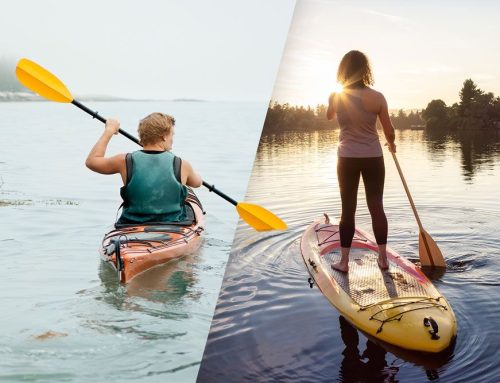
Recreational kayaks are the most common boats on the water. They are typically 9–12 feet long, wide, stable, and inexpensive ($300–$800). Large cockpits make getting in and out easy. They are ideal for calm lakes, slow rivers, and casual bay paddling. Most beginners start here, and many paddlers never need anything else. The trade-off: they are slow, catch wind easily, and lack the storage and seakeeping ability of touring boats. See our picks for best recreational kayaks.
Touring / Sea Kayaks
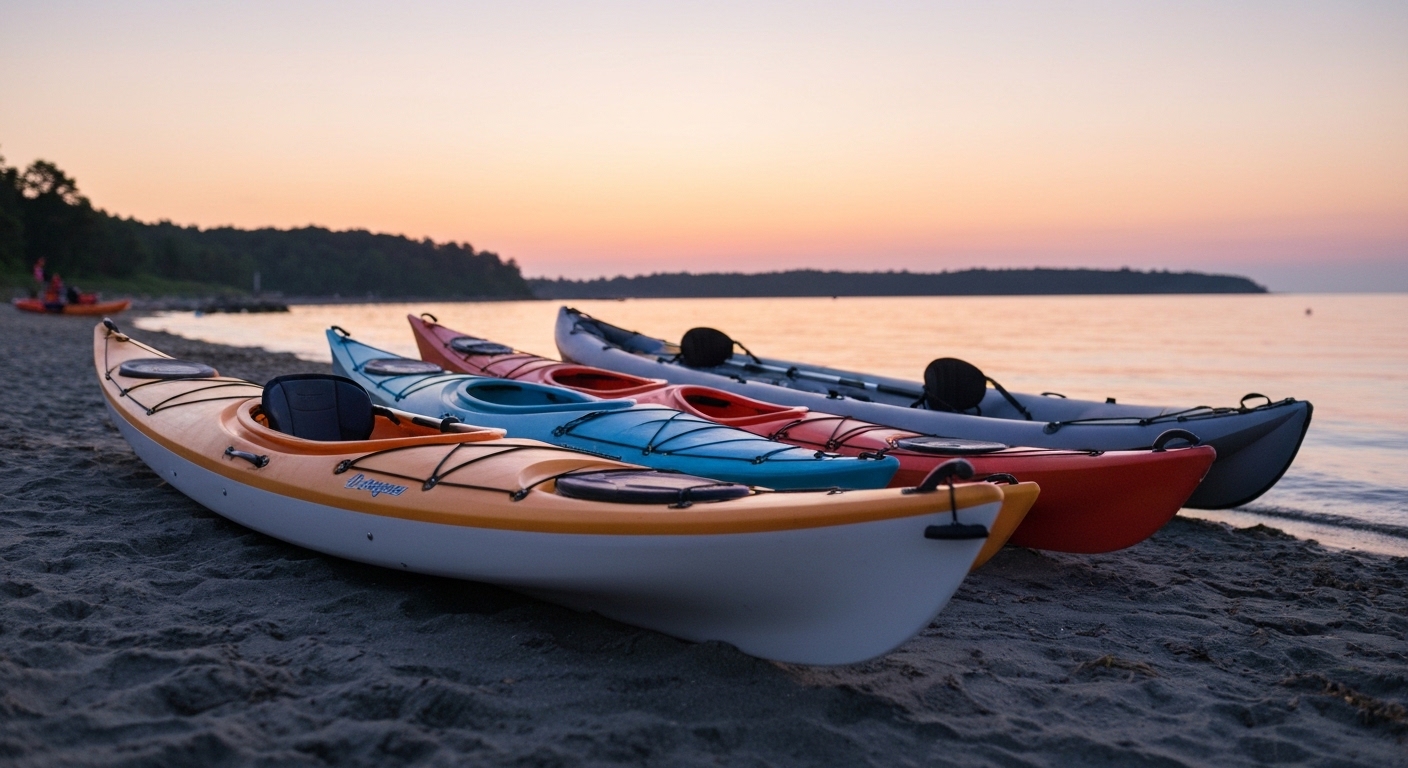
Touring kayaks are 14–18 feet long with a narrow beam, multiple sealed hatches, and a pronounced keel or rudder system for straight tracking. They are built for covering distance—multi-day trips, coastal exploration, and open-water crossings. They are significantly faster than recreational boats but require more skill to handle and cost more ($1,000–$4,000+). If you plan to paddle more than a couple of hours at a stretch or explore remote coastlines, a touring kayak pays off quickly.
Fishing Kayaks
Fishing kayaks prioritize stability, storage, and rigging options over speed. They are typically wide (30–36 inches), short to medium in length (10–14 feet), and loaded with rod holders, gear tracks, tackle storage, and often a raised seat for sight-fishing. Many now offer pedal-drive or motor-assist options that free your hands for casting. If fishing is your primary reason for being on the water, a purpose-built fishing kayak beats adapting a general boat.
Sit-on-Top Kayaks
Sit-on-top (SOT) kayaks have a molded open deck—you sit on top of the hull rather than inside it. Scupper holes drain water automatically. They are self-bailing, easy to remount after a capsize, and ideal for warm weather, snorkeling, beach launches, and casual fishing. The downsides: you get wetter, they are heavier than comparable sit-insides, and they are slower in cold or rough water. For warm climates and casual use, SOTs are often the better choice. Read our deep dive on sit-in vs sit-on-top kayaks.
Sit-Inside Kayaks
Sit-inside kayaks enclose your lower body inside a cockpit. Combined with a spray skirt, they keep you warmer and drier—critical in cold climates or rough water. They also offer better paddling efficiency because your body is more connected to the hull. The learning curve is steeper: re-entering after a capsize requires practice. Sit-insides dominate touring, sea kayaking, and whitewater.
Inflatable Kayaks
Modern inflatables bear little resemblance to cheap pool toys. High-end inflatable kayaks use drop-stitch construction and PVC or Hypalon fabrics that are rigid under pressure, track reasonably well, and handle Class II–III rapids or open-water touring. They pack into a bag, fit in a car trunk, and store in an apartment closet. The trade-offs are real—they are slower than hardshells, can be damaged by sharp rocks, and take 5–10 minutes to inflate. But for people with limited storage or transport options, they are the most practical entry point. Explore the best options in our best inflatable kayaks guide.
Tandem Kayaks
Tandem kayaks seat two paddlers and are sometimes called “divorce boats” by paddling instructors—paddling in sync with another person takes communication and patience. That said, tandems are excellent for parents paddling with young children, couples who want to share the experience, or situations where one paddler needs assistance. They are longer and heavier than solo boats, which affects transportation and car-topping. Some tandem kayaks can be paddled solo by repositioning the seat.
Pedal-Drive Kayaks
Pedal-drive kayaks use foot-powered propulsion—either a fin-drive system (like a fish tail) or a propeller—to move the boat without paddling. This frees both hands for fishing, photography, or eating a sandwich. They are heavier and more expensive than paddle kayaks, and the drive units can snag in shallow water or weeds. For serious fishing kayakers, a pedal drive is often worth every penny. For casual paddlers, it is usually overkill.
Whitewater Kayaks
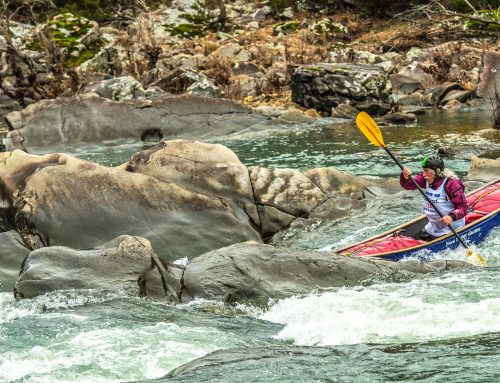
Whitewater kayaks are short (6–9 feet), highly rockered, and built to spin quickly and survive impacts. There are several sub-types: creek boats for steep technical runs, playboats for tricks and surfing waves, and river runners for general moving-water use. They require proper instruction and on-water skills before you attempt anything beyond Class I water. If you are drawn to rivers and rapids, invest in a whitewater course before investing in a whitewater boat.
Folding and Modular Kayaks
Folding kayaks—brands like Oru and Pakayak—use a rigid frame or interlocking sections that collapse for transport and storage. They paddle more like hardshell kayaks than inflatables and are popular with urban paddlers who travel frequently. They are expensive ($700–$2,000+) but solve the storage problem without sacrificing on-water performance.
- Recreational — calm lakes, rivers, casual day paddles
- Touring/Sea — multi-day trips, coastal paddling, open water
- Fishing — angling, hands-free casting, gear storage
- Sit-on-Top — warm climates, snorkeling, beach launches
- Inflatable — limited storage/transport, travel, casual use
- Tandem — paddling with a partner or child
- Pedal-Drive — hands-free fishing, longer distances
- Whitewater — rapids, rivers, technical water
- Folding/Modular — urban storage, frequent travel
Hardshell vs. Inflatable: The Core Decision
Every kayak buyer eventually faces this question. Here is the honest breakdown.
Hardshell kayaks (rotomolded polyethylene, thermoformed ABS, fiberglass, or carbon fiber) are stiffer, faster, more durable against abrasion, and better-performing in rough water. They last decades with basic care. The downside is transport and storage: a 12-foot recreational kayak weighs 45–65 pounds and requires a roof rack or truck bed. If you have a garage and a vehicle that can handle roof-topping a boat, hardshell is almost always the better performing option.
Inflatable kayaks solve the logistics problem. A packable inflatable that fits in a 30-pound bag is genuinely useful if you live in an apartment, travel by plane to paddle destinations, or simply cannot deal with the overhead of strapping a boat to your car every weekend. Modern drop-stitch inflatables from brands like Advanced Elements, Aquaglide, and Sea Eagle perform well enough that the performance gap with entry-level hardshells is smaller than most people expect.
The rule of thumb: if storage and transport are not obstacles, buy a hardshell. If they are, a quality inflatable will get you on the water and keep you there.
How to Choose the Right Type for You
Skip the spec-sheet rabbit holes. Answer these five questions first, and the right category becomes obvious.
- Where will you paddle? Calm flatwater (lake, slow river, protected bay) = recreational or sit-on-top. Coastal or open water = touring. Moving rivers = whitewater or river runner. Reservoir for fishing = fishing kayak.
- How far and how long? Under two hours, casual pace = recreational. Half-day to full-day = recreational or entry touring. Multi-day = touring with hatches and sealed bulkheads.
- What is your climate? Warm and sunny = sit-on-top works great. Cold water or cold climate = sit-inside with a spray skirt, and consider a drysuit.
- Can you store and transport a hardshell? Yes = hardshell almost always. No = quality inflatable or folding kayak.
- Are you paddling solo or with someone? Solo = standard single. With a partner or child regularly = tandem. With a child occasionally = some singles have a front well that fits a small child with a PFD.
Once you know your category, budget and length are the next filters. Longer boats go faster and track better; shorter boats turn easier and are lighter to carry. For beginners, erring toward a bit more length (10–12 feet for recreational) gives you a more enjoyable experience sooner.
Browse all our curated picks in our kayak guides to see top-rated boats in each category.
Hull Shape and What It Means for You
You will encounter hull terminology on every spec sheet. Here is what it actually means in practice.
Primary vs. secondary stability: Primary stability is how stable the kayak feels when you first sit in flat water—wide, flat-hulled boats have high primary stability and feel solid immediately. Secondary stability is how well the kayak resists capsizing when it is leaned on edge in moving water. High-performance touring and sea kayaks trade some primary stability for better secondary stability, which takes a few sessions to get comfortable with.
Rocker: As noted in the anatomy section, rocker describes how much the hull curves upward at the bow and stern. High rocker = maneuverable, good for rivers. Low rocker = tracks straight, good for open water and distance paddling.
Chines: The transition from the bottom of the hull to the sides. Hard chines create a defined edge and give more predictable secondary stability. Soft chines create a smoother curve and a more forgiving, rounded feel.
For most beginners, hull shape matters less than simply getting on the water in a category-appropriate boat. As your skills develop, you will start to feel the differences and know what to prioritize in your next boat.
What to Buy First: A Beginner's Honest Recommendation
If you are brand new to kayaking and not sure where to start, this is the practical path most people do not regret:
Rent before you buy. Most outfitters charge $25–$60 for a half-day rental. Try a recreational sit-inside, a sit-on-top, and if possible a fishing kayak. A few hours on the water will tell you more about what you want than any article can.
Buy used for your first boat. The used kayak market is robust. A lightly used 10-foot recreational kayak in good condition typically runs $150–$350—a fraction of retail. Paddle it for a season. If you stick with the sport, you will know exactly what you want in a second boat.
Do not skip the paddle. A cheap boat with a good paddle beats an expensive boat with a heavy, poorly balanced paddle every time. Budget at least $80–$150 for a paddle alongside whatever boat you choose.
Wear your PFD. A personal flotation device is not optional. Capsizing happens to experienced paddlers in calm water. Buy one that fits, wear it every time.
When you are ready to narrow down a category, our best recreational kayaks guide and our best inflatable kayaks guide both include honest, tested picks at every price point. If you are comparing cockpit styles, our guide to sit-in vs sit-on-top kayaks walks through the decision in detail.
Frequently Asked Questions
What is the difference between a kayak and a canoe?
What type of kayak is best for beginners?
How much does a kayak cost?
Can I use a recreational kayak on the ocean?
What is a sit-on-top kayak good for?
Are inflatable kayaks worth buying?
Sit-in vs sit-on-top →Best recreational kayaks →Best inflatable kayaks →All kayak guides →