
The Physical and Health Advantages of Surf Boarding
Surfing is a legitimate full-body workout that builds muscle, torches calories, and trains your cardiovascular system — all while you're having too much fun to notice.
We talk a lot about the mental and lifestyle side of surfing, but the physical numbers deserve their own spotlight. The health benefits of surfing stack up against dedicated gym sessions, and the data backs that up.
What Muscles Does Surfing Work?
Surfing is one of the few activities that demands heavy recruitment from nearly every major muscle group — often within the same 30-second wave ride. The session breaks into two distinct phases, and each one targets a different set of muscles.
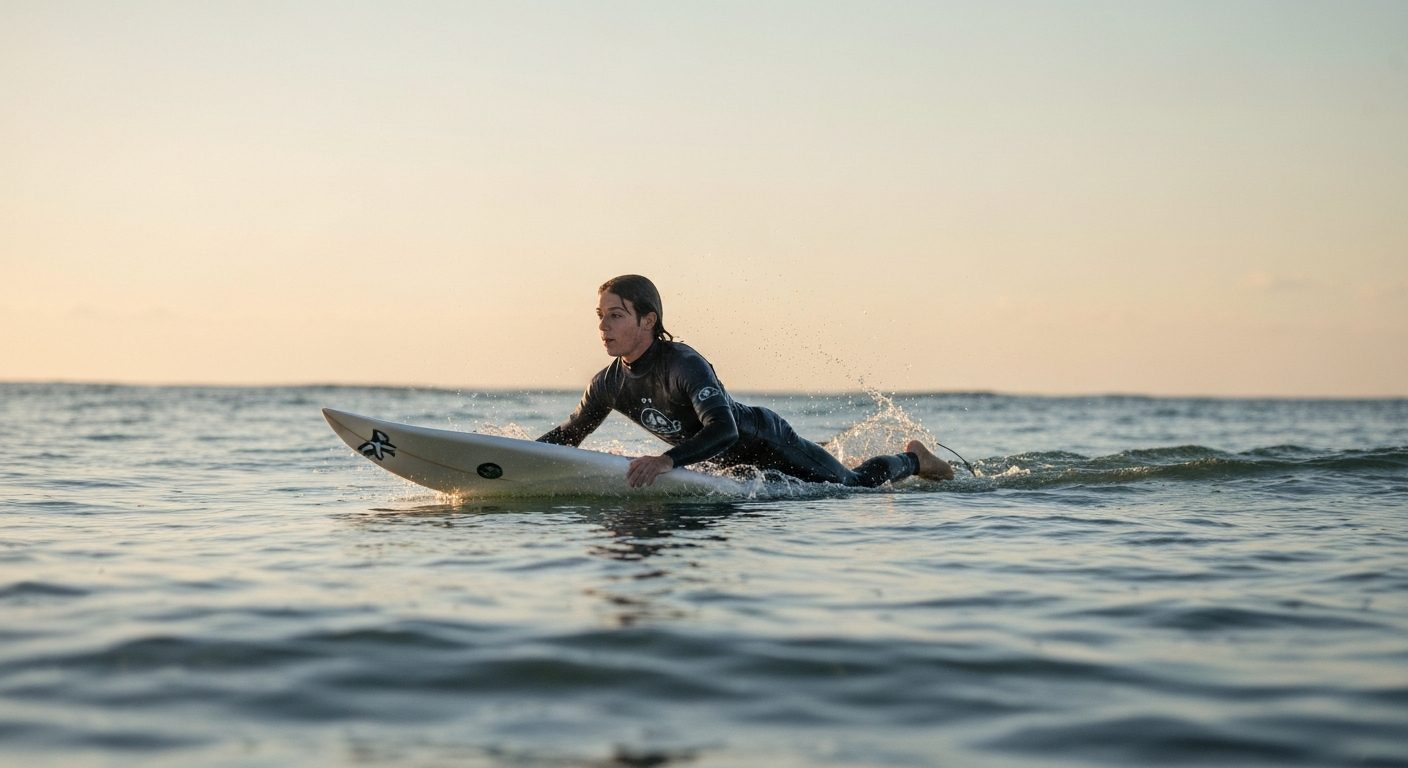
Paddling out is where you spend the majority of your time, especially as a beginner. Every stroke is essentially a crawl-stroke pull combined with a core-stabilization hold. Over an hour-long session you might paddle two to four miles. The primary movers here are your latissimus dorsi, posterior deltoids, triceps, and rhomboids. Your rotator cuff muscles work overtime as stabilizers, which is why paddling is genuinely therapeutic for posture if done consistently.
The pop-up is an explosive push-press movement. Your triceps, pectorals, and anterior deltoids fire to drive your torso off the board, while your hip flexors and quadriceps snap your legs into position beneath you. The whole movement takes about half a second and taxes your fast-twitch fibers heavily.
Riding is where the lower body and core take over. Maintaining a low athletic stance — knees bent, hips dropped, weight forward — is an isometric quad and glute hold. Steering through turns recruits your obliques and hip abductors. Bracing against the board’s motion in chop or whitewater forces constant micro-corrections from your deep spinal stabilizers and calves.
| Phase | Primary Muscles | Supporting Muscles |
|---|---|---|
| Paddling | Lats, posterior deltoids, triceps | Rhomboids, rotator cuff, core |
| Pop-up | Triceps, pecs, hip flexors, quads | Anterior deltoids, glutes |
| Riding & turning | Quads, glutes, obliques | Calves, hip abductors, deep spinal stabilizers |
| Duck-diving / turtle roll | Triceps, shoulders, core | Lats, hip flexors |
The net result is a session that hits pulling muscles (back, biceps), pushing muscles (chest, triceps, shoulders), and lower-body/core — the trifecta that most gym programs try to hit over three separate days.
How Many Calories Does Surfing Burn?
Calorie burn in surfing is highly variable because the workload shifts constantly — you’re not moving at a steady pace on a treadmill. That said, the research and the field data point to a meaningful range.
- Beginner (mostly paddling, few rides): 150–250 kcal/hr
- Intermediate (consistent riding, active sessions): 250–350 kcal/hr
- Advanced (powerful waves, frequent pop-ups, duck-dives): 350–450+ kcal/hr
Body weight scales these numbers up or down — a 130 lb surfer burns less than a 200 lb surfer at the same effort level, roughly in proportion to the weight difference. Water temperature matters too: your body expends extra energy thermoregulating in cold water, nudging calorie burn upward by 5–10% even without a wetsuit change in effort.
What makes surfing especially effective from a calorie standpoint is the duration. Most gym cardio sessions last 20–40 minutes because they’re mentally fatiguing. A surf session routinely runs 90 minutes to two hours because the wave-catching reward loop keeps you motivated. A 2-hour intermediate session at 300 kcal/hr equals 600 calories — comparable to a solid 10K run, but with dramatically better scenery.
If you’re shopping for a board that makes paddling more efficient and gets you to your feet faster, our best beginner surfboards guide covers the shapes that maximize your time actually riding versus sitting on the shoulder catching your breath.
Cardiovascular and Endurance Benefits
Surfing is legitimately aerobic. Paddling keeps your heart rate in the 120–150 bpm range for extended stretches, squarely in the zone that improves VO2 max and cardiovascular efficiency over time. A 2018 study published in the Journal of Strength and Conditioning Research found that competitive surfers had cardiovascular fitness levels comparable to swimmers and cyclists — sports we think of as purely aerobic.
The interval nature of surfing — burst of hard paddling, rest on the lineup, explosive pop-up, recovery paddle back out — mirrors high-intensity interval training (HIIT). HIIT has a well-documented advantage over steady-state cardio for improving insulin sensitivity, fat oxidation, and cardiovascular adaptations in less total time. Surfing delivers that stimulus without you having to think about it.
Consistent surfing also improves lung capacity and breath-hold tolerance. When a wave holds you under, your body adapts over weeks and months to tolerate elevated CO2 more calmly, which has measurable benefits for breath control during other aerobic activities.
For a broader look at what the sport does for you beyond the physical, our post on why surfing is beneficial covers the mental and lifestyle dimensions in depth.
According to the International Surfing Association, surfing is recognized globally as a competitive sport demanding elite-level fitness across multiple physical domains — a designation that reflects just how demanding the sport truly is at any level.
Balance, Mobility, and Core Strength
If there’s one physical quality that surfing develops better than almost any gym exercise, it’s proprioception — the body’s sense of its own position in space. Riding a moving, curved surface in dynamic water forces your nervous system to make constant micro-corrections. Over time, that trains the small stabilizing muscles around your ankles, knees, hips, and spine that conventional strength training often misses entirely.
Core strength in surfing isn’t about crunches. It’s about anti-rotation and bracing — resisting the forces trying to throw you off the board rather than generating force yourself. That distinction matters. The muscles trained are your transverse abdominis, multifidus, and quadratus lumborum — the deep stabilizers that protect your spine and are often undertrained in people with chronic lower back pain.
Mobility gets a serious workout too. The pop-up demands hip flexor flexibility and thoracic spine rotation. Riding requires deep knee flexion (ankle mobility), and repeated sessions gradually improve functional range of motion in ways that static stretching can’t fully replicate because the movement is loaded and dynamic.
- Balance: Unstable surface training improves single-leg balance scores measurably within 4–6 weeks of regular surfing.
- Hip mobility: The pop-up hip hinge pattern carries over directly to better squat and deadlift mechanics.
- Shoulder stability: Rotator cuff endurance improves as paddling volume accumulates, reducing shoulder injury risk in other activities.
- Ankle mobility: The low athletic stance actively stretches and strengthens the dorsiflexion range that desk workers chronically lose.
If you’re new to the sport and want to build these qualities from day one, our how to surf for beginners guide walks through the fundamentals that reinforce good movement patterns early.
Low-Impact, Full-Body Training You'll Actually Do
One of surfing’s underappreciated fitness advantages is that it’s extremely low impact relative to how much work it demands. Unlike running, which loads each knee joint with two to three times bodyweight per footstrike, surfing puts almost no compressive load on your joints. The water supports your body weight during paddling, and riding involves bending into waves rather than absorbing vertical impact forces.
That matters for two groups of people in particular. First, surfers who are aging or dealing with joint wear can often continue surfing well into their 50s, 60s, and beyond — staying active in ways that would be painful or impossible if they were still running or playing high-impact team sports. Second, it means surfing makes an excellent cross-training activity for athletes in high-impact sports who need cardiovascular and strength training without adding more joint stress.
From a compliance standpoint — which is really what determines long-term fitness results — surfing has an enormous advantage over gym training. People show up. They don’t skip a surf session because they’re not feeling motivated the way they skip a treadmill session. The external reward (waves, outdoors, social lineup culture) provides the motivation that willpower alone can’t sustain indefinitely.
The combination of full-body muscle recruitment, genuine cardiovascular stimulus, low joint impact, and high session adherence puts surfing in a rare category: a sport that functions as a complete fitness protocol, not just a recreational hobby. If you’re evaluating whether to invest in learning, that’s a meaningful piece of the value equation.
Frequently Asked Questions
What muscles does surfing work?
Surfing works nearly every major muscle group. Paddling targets the lats, posterior deltoids, triceps, and rhomboids. The pop-up recruits the pecs, anterior deltoids, and hip flexors. Riding and turning engage the quads, glutes, obliques, and deep core stabilizers. Duck-diving hits the shoulders and triceps again. Over a full session, you’ve effectively done pulling, pushing, and lower-body work in one continuous workout.
How many calories does surfing burn?
Calorie burn ranges from roughly 150 to 450+ calories per hour depending on your skill level, body weight, and wave conditions. Beginners burn toward the lower end because they spend more time resting on the lineup. Advanced surfers in punchy surf can exceed 400 kcal/hr. Because surf sessions typically run 90–120 minutes, total burn per outing often rivals a solid 10K run.
Is surfing a good workout?
Yes — surfing is an excellent full-body workout that delivers cardiovascular, strength, and mobility benefits in a single session. It keeps your heart rate elevated for extended periods, recruits muscles across your upper body, core, and legs, and trains balance and proprioception that most gym workouts miss. The high session adherence (people actually want to show up) makes it especially effective as a long-term fitness habit.
Is surfing cardio or strength training?
Surfing is both. Paddling is sustained aerobic cardio that keeps your heart rate in the 120–150 bpm range for long stretches. The pop-up is explosive strength work that taxes fast-twitch muscle fibers. Riding is isometric strength endurance for your legs and core. The interval structure — hard effort, rest, hard effort — mirrors HIIT protocols shown to improve VO2 max and muscular endurance simultaneously.
Can surfing get you in shape?
Absolutely. Consistent surfing — two to three sessions per week — builds real cardiovascular fitness, functional strength, and body composition changes over weeks and months. It’s not a shortcut, but it’s a complete enough stimulus that many regular surfers do little or no supplemental gym work. The key is consistency. Because it’s enjoyable, surfers tend to stick with it far longer than conventional workout programs, which is where the real results compound.