The Mental and Physical Advantages of Paddleboarding
One sport. Two payoffs. Paddle boarding builds a stronger body and a calmer mind at the same time — and the science behind both sides is surprisingly compelling.
If you’ve ever stepped off a paddleboard after an hour on the water and thought “why do I feel so good right now?” — you’re not imagining things. Stand-up paddle boarding delivers a rare double benefit: a legitimate full-body workout wrapped inside an experience that actively dials down stress. This article breaks down exactly what’s happening to your body and your brain when you paddle, so you can decide whether it belongs in your regular routine.
A Full-Body Workout That Doesn't Feel Like One
Most cardio machines isolate a narrow set of movements. Paddle boarding does the opposite. Every stroke pulls through your hands, forearms, biceps, shoulders, and lats — while your core braces to keep the board flat, your glutes and quads absorb the board’s movement, and your feet and ankles make dozens of micro-adjustments per minute to maintain balance.
The result is a workout that recruits muscle groups most gym routines leave unaddressed. Your stabilizer muscles — the small, deep muscles around your hips, spine, and ankles — get a training stimulus they rarely receive on land. Over weeks of consistent paddling, this translates to better posture, reduced lower-back tension, and noticeably improved balance on and off the water.
Curious about exactly what muscles does paddle boarding work? We mapped out every primary and secondary muscle group in detail — it’s a longer list than most people expect.
Core Strength and Balance: The Quiet Engine of Every Paddle
Stand on an unstable surface and your core fires automatically. That’s the basic mechanic behind why SUP is so effective for core development. Unlike crunches or planks — exercises with a definite start and stop — paddling keeps your core under continuous low-level contraction for the entire session.
Research published in the Journal of Strength and Conditioning Research found that balance-demanding activities like SUP activate deep stabilizing muscles (including the transverse abdominis and multifidus) more consistently than many traditional core exercises. Those are the same muscles physical therapists target during lower-back rehabilitation.
Balance improvements tend to show up quickly — most new paddlers notice a real difference within three to five sessions. The board stops feeling like it’s trying to throw you off and starts feeling like an extension of your body. That shift happens because your nervous system is learning, not just your muscles.
Low-Impact Cardio and Calorie Burn
One of paddle boarding’s underrated advantages is what it doesn’t do to your joints. Running generates ground-reaction forces roughly 2.5 times your body weight with every stride. Paddle boarding generates almost none — your joints absorb the gentle motion of water, not repeated hard impacts. That makes it an accessible cardio option for people with knee or hip issues, and a smart recovery-day alternative for athletes who need to keep their heart rate up without beating up their legs.
On the cardio side, SUP can range from a light recreational paddle (roughly equivalent to a brisk walk) up to a high-intensity interval session if you push the pace. The calories burned paddle boarding vary widely based on body weight, paddling intensity, and water conditions — but recreational paddling typically falls in the 300–430 calorie-per-hour range, while touring or racing pace can push past 600.
That’s competitive with cycling and swimming for cardiovascular training — with the added benefit that it doesn’t feel like exercise to most people, which means they actually do it consistently.
Flexibility, Endurance, and Long-Term Athletic Development
A full paddling stroke involves rotation through the thoracic spine — the mid-back region that most desk workers have gradually locked up over years of sitting. Paddling regularly encourages that rotation, which over time improves functional flexibility in the back and shoulders.
Endurance builds gradually with paddle boarding because sessions tend to be longer than typical gym workouts. It’s not unusual for recreational paddlers to spend 60–90 minutes on the water without realizing how much time has passed. That extended, moderate-intensity effort is exactly the training zone that builds aerobic base — the foundation for cardiovascular health, metabolic efficiency, and stamina across other activities.
For a comprehensive look at whether the activity holds up as genuine exercise, read our breakdown of is paddle boarding good exercise — including how it compares to other cardio formats by intensity and training benefit.
Stress Reduction and the Blue Mind Effect
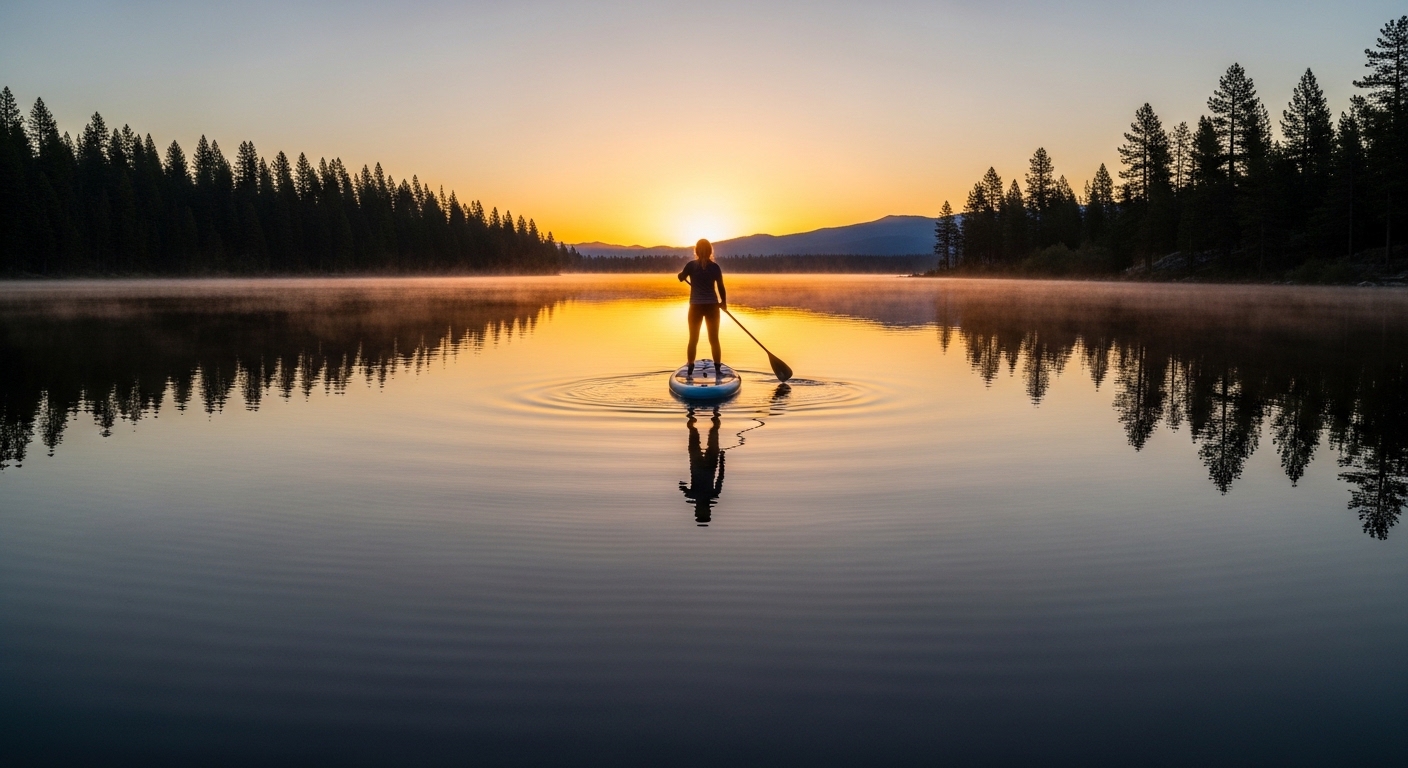
Marine biologist Wallace J. Nichols popularized the term “blue mind” to describe the measurable shift in brain state that occurs near, in, or on water. His research, along with supporting work in environmental psychology, shows that water environments consistently lower cortisol levels, reduce activity in the brain’s default mode network (the region associated with rumination and anxiety), and produce what researchers describe as a mild meditative state.
Paddle boarding puts you directly in that environment — often away from traffic, screens, and noise — for an extended period. The combination of rhythmic physical movement, natural surroundings, and the gentle sensory input of water creates conditions that are neurologically quite different from a treadmill in a gym or a stationary bike in your living room.
The effect isn’t placebo. A 2021 study in Frontiers in Psychology found that blue space exposure (environments featuring water) was associated with significantly lower psychological distress and higher wellbeing scores across a large population sample. SUP delivers that exposure as a built-in feature of the activity.
Mindfulness, Flow State, and What Happens When You Can't Think About Work
Stand-up paddling has a natural mindfulness mechanism that most people don’t notice until someone points it out: the board demands your attention. If you drift mentally and stop making micro-corrections, you wobble. That constant feedback loop pulls you into the present moment in a way that’s hard to replicate on autopilot exercises like running or cycling.
Psychologist Mihaly Csikszentmihalyi described “flow” as the mental state of complete absorption in a challenging but manageable task. Paddle boarding sits in that zone for most people — it requires enough concentration to quiet mental chatter, but not so much that it becomes frustrating. The result is a session that functions as active meditation, even if you never think of it that way.
Vitamin D is another quiet contributor here. Paddling outdoors exposes you to natural sunlight, which triggers the synthesis of vitamin D — a hormone that plays roles in mood regulation, immune function, and sleep quality. Deficiency is widespread in populations that spend most of their time indoors, and outdoor activities like SUP are one of the most efficient ways to address it.
Mood, Sleep, and the Social Dimension
The mood benefits of aerobic exercise are well-documented — physical activity triggers the release of endorphins, dopamine, and serotonin, all of which contribute to improved emotional state and reduced symptoms of depression and anxiety. Paddle boarding delivers those biochemical benefits while adding the environmental and social components that most gym workouts lack.
Regular paddlers frequently report better sleep quality, which makes physiological sense. You’ve combined meaningful physical exertion, stress reduction, outdoor light exposure (which regulates circadian rhythm), and time away from screens — all factors that support deeper, more restorative sleep.
The social dimension is easy to overlook but genuinely meaningful. Paddle boarding is done in groups as easily as alone. Paddling with friends or joining a local SUP club adds social connection, accountability, and the mood benefits associated with shared physical activity. Research consistently shows that exercising with others increases adherence — people show up more often when someone else is expecting them.
For a broader look at how all of this stacks up, our guide to paddle boarding health benefits covers the full picture, including heart health, immune function, and weight management.