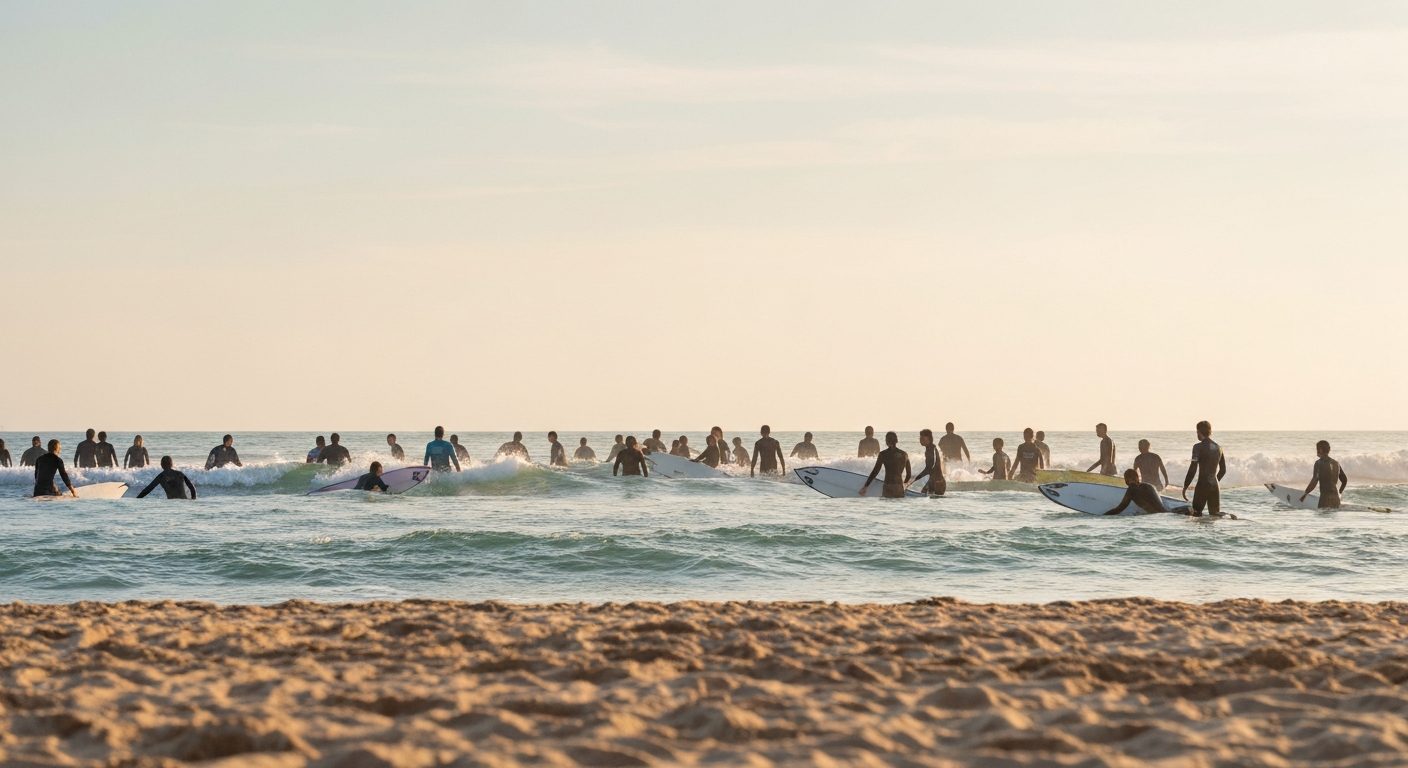
Popularity Rise for Surfing
Surfing has never had more people paddling out — and there are very good reasons why.
Walk into any coastal surf shop on a summer weekend and you will find a line out the door for beginner lessons. Drive past an inland wave park and the parking lot is full by eight in the morning. Something real is happening with surfing’s popularity, and it is not a fluke.
The Olympic Effect: Surfing on the World Stage
The single biggest structural shift in surfing’s visibility happened on July 27, 2021, when Italo Ferreira of Brazil dropped into a barrel at Tsurigasaki Beach and surfing made its Olympic debut at the Tokyo Games. For a sport that had spent decades being described as a counterculture lifestyle, suddenly it was sitting alongside swimming and gymnastics in front of a global prime-time audience.
The Tokyo broadcast reached an estimated 3.05 billion viewers across all platforms. Coaches and surf school owners across the United States, Australia, and Europe reported a measurable uptick in lesson inquiries in the weeks that followed. That is how powerful the Olympic brand is — it confers legitimacy on a sport in a way that even the most successful professional tour cannot.
Then came Paris 2024. The organizers did not just slot surfing into a local venue. They sent the athletes to Teahupo’o, Tahiti — one of the most photographed and most feared waves on Earth. The imagery that came out of those heats was extraordinary. A heavy, glassy barrel breaking over a shallow reef, filmed from helicopters and underwater drones, broadcast to hundreds of millions of people who had never given surfing a second thought. Many of them started Googling “how to learn to surf” before the medal ceremony was over.
And the momentum is not stopping. The 2028 Los Angeles Olympics will bring surfing home to Southern California, the spiritual birthplace of modern surf culture. The contest venue at Teahupo’o during Paris 2024 alone drove a reported surge in French Polynesia surf tourism. LA 2028 is likely to do the same for the California coast and the broader U.S. market. The Olympic pipeline for new surfers is open, and it will stay open for years.
Wave Pools and Surf Parks: Surfing Without the Ocean
For most of surfing’s history, you needed to live near the coast to become a surfer. That geographic barrier kept the sport’s potential audience artificially small. Wave pools changed everything.
Kelly Slater’s Surf Ranch in Lemoore, California — roughly three hours inland from the nearest surfable break — opened to the public in 2018 and immediately proved that world-class, perfectly shaped waves could be manufactured on demand in a landlocked agricultural valley. Since then, the wave pool industry has exploded. Wavegarden, UNIT Surf Pool, American Wave Machines, and dozens of other technology developers have planted facilities in places like Austin, Texas; London, England; Waco, Texas; and suburban Sydney, Australia.
The implications are enormous. A family in Kansas City or Columbus or Denver can now book a two-hour surf session at a regional wave park, get proper instruction, and catch actual unbroken waves on their first visit. That experience — the real physical sensation of riding a wave — is the hook. Once someone feels it, they want more. Many of them start planning a beach vacation specifically around surfing for the first time. The wave pool becomes a feeder system for coastal surf tourism and for the sport itself.
Wave parks have also accelerated skill development in ways that were previously impossible. A surfer at a natural break might catch eight to twelve waves in a two-hour session on a good day. At a wave pool, that same surfer can catch thirty to fifty waves, each one predictable in timing, shape, and direction. The learning curve compresses dramatically. Beginners become intermediates faster, and intermediates start thinking seriously about chasing swells at real breaks. The pipeline from park to ocean is real and it feeds long-term participation.
The Pandemic Outdoor Boom and the Foam Board Revolution
When the world shut down in 2020, people went outside. Hiking, cycling, kayaking, paddleboarding, and surfing all saw participation spikes as people looked for activities that were socially distanced, physically demanding, and available without a gym membership. Surfing benefited from that shift in a lasting way — many of the people who tried it during or just after the pandemic stuck with it.
At the same time, the equipment available to beginners improved dramatically. The soft-top foam surfboard — once seen as a toy for toddlers — had a genuine quality revolution in the late 2010s. Brands like Wavestorm, Softech, Catch Surf, and Degree 33 started making foam boards that were genuinely good to surf, stable enough for true beginners but buoyant and responsive enough that intermediates enjoyed riding them too. Prices dropped. A decent beginner foam board now retails for $150 to $350, compared to $600 to $900 for a traditional fiberglass longboard.
Lower cost plus higher quality plus COVID-era outdoor enthusiasm added up to a massive expansion of the beginner pool. Surf schools that closed temporarily during lockdowns reopened to waiting lists. Board rentals became the most profitable part of many surf shops’ businesses. If you want to understand what beginner surfboards look like today versus even a decade ago, the shift is striking — the barriers that used to keep people out of the water have largely been removed.
The beginner experience is also better structured now. Learning to surf used to mean borrowing a friend’s board and getting worked by whitewater with no instruction. Today there are organized lesson programs, certified instructors, and a clear progression path from foam board to fiberglass. That structure matters for retention. People who have a good first experience come back. People who get thrashed and confused do not.
Social Media, Surf Culture, and the Lifestyle Pull
Surfing has always sold a lifestyle alongside the sport itself. The golden-hour beach light, the pre-dawn paddle-out, the feeling of being the first one in the water on a glassy morning — these images have been part of surfing’s cultural vocabulary since Bruce Brown’s The Endless Summer in 1966. What social media did was put those images into the feeds of hundreds of millions of people who had never thought much about surfing before.
Instagram and TikTok have been particularly powerful. A GoPro clip of a clean barrel in Bali or a sunset longboard session in Malibu can accumulate millions of views from landlocked viewers who respond to something elemental in the imagery. The comments on those videos are full of people saying “I need to try this” and “adding this to my bucket list.” A meaningful percentage of them follow through.
Surf culture’s aesthetic has also permeated fashion, music, and broader lifestyle branding in a way that keeps it aspirationally relevant. It is not just about waves. It is about a certain relationship to nature, to physical challenge, to the rhythm of tides and seasons. That appeal cuts across demographics. We see it in the range of people showing up at beginner lessons — retirees, college students, parents with young kids, urban professionals on vacation. The lifestyle pull is broad.
- YouTube surf channels routinely generate tens of millions of annual views, with tutorial content being among the most searched.
- Surf brands like Patagonia, Quiksilver, and Rip Curl have expanded their audiences well beyond core surfers by leaning into environmental and wellness messaging.
- Surf trip search volume on travel platforms has increased year over year since 2021.
The Wellness and Mental Health Draw
Surfing is physically demanding in ways that are genuinely good for the body — it builds shoulder and core strength, improves balance, and demands cardiovascular fitness. But the mental health dimension of the sport is what a growing number of people are showing up for, and researchers are paying attention.
Multiple peer-reviewed studies have found measurable reductions in anxiety, depression, and PTSD symptoms among regular surfers and among participants in surf therapy programs. Organizations like the Surfrider Foundation have documented how consistent time in the ocean correlates with improved mood and stress reduction. The mechanism is not complicated: surfing forces you to be completely present. You cannot think about work emails when you are reading a wave, paddling to position, and timing your pop-up. The cognitive demand crowds out everything else.
This is not incidental to surfing’s growth — it is increasingly central to how people talk about why they surf and why they want to start. The benefits of surfing extend well beyond fitness. We hear this from people in surf lessons all the time: “I just need to get out of my head.” Surfing delivers on that in a way that a treadmill or a spin class rarely does. The ocean itself — the light, the temperature, the smell, the movement — engages the senses completely, and that full sensory engagement appears to be a genuine driver of the mental health effect.
Surf therapy programs for veterans, at-risk youth, and people recovering from trauma have expanded significantly since 2018. Those programs both benefit from and contribute to surfing’s broader cultural credibility as something more than recreation — as a form of meaningful engagement with the natural world.
What This Means for Crowds and Beginners Just Starting Out
We want to be honest about the flip side of all this growth, because pretending it does not exist would be doing you a disservice. More surfers means more crowded lineups. Popular breaks that were uncrowded ten years ago now have waiting periods at peak times. Localism — the informal (and occasionally hostile) territorial behavior by experienced surfers toward newcomers — has become more visible at some spots as competition for waves increases.
None of that should stop a beginner from learning. It just means being smart about it.
- Start in whitewater, not the lineup. Beginner lessons always work in the broken whitewater zone, not out where experienced surfers are competing for unbroken waves. That separation exists for good reason and eliminates most friction.
- Go at off-peak times. Dawn patrol sessions before nine in the morning are less crowded at nearly every break in the world. So are weekday mornings.
- Use the right equipment. A wide foam board in the whitewater is a signal to everyone in the water that you are a beginner, and most experienced surfers give beginners appropriate space and patience when the setup is correct.
- Learn the rules of the road. Right of way in surfing is not complicated. Understanding who has priority on a wave eliminates most conflict before it starts.
The history of surfing is one of continuous growth and adaptation. The roots of the sport go back centuries, and it has absorbed waves of new participants before — after The Endless Summer in the 1960s, after the shortboard revolution, after the 1990s longboard revival. The culture adapts. The water is still there. There has never been a better time to start, and the combination of better equipment, better instruction, and accessible wave parks means the entry point has never been lower.
Frequently Asked Questions
Why is surfing getting more popular?
A combination of forces arrived at the same time: the Olympic debut in Tokyo 2021 brought global visibility, wave pools made surfing accessible to inland populations, the pandemic outdoor boom pushed people toward ocean activities, and social media kept surf culture aspirationally visible year-round. Better and cheaper beginner equipment — specifically high-quality foam boards — also dramatically lowered the cost and difficulty of getting started, which expanded the potential audience significantly.
Is surfing an Olympic sport?
Yes. Surfing made its Olympic debut at the Tokyo 2020 Games (held in 2021) and returned at Paris 2024, where competition was held at the legendary Teahupo’o break in Tahiti. It is confirmed for the 2028 Los Angeles Games. The Olympic inclusion has meaningfully raised the sport’s global profile and driven measurable increases in beginner participation in the years following each Games.
Are wave pools real surfing?
They are genuinely surfing — the physics of riding a wave are identical whether the wave is generated by ocean swell or a mechanical system. What wave pools lack is the natural variability and reading-the-ocean skill development that comes from surfing real breaks. What they offer is consistency, accessibility, and a compressed learning environment where beginners can catch far more waves per session than they would at most natural breaks, which accelerates skill development considerably.
Is surfing growing as a sport?
Yes, by every measurable metric. Surf school enrollments, board sales, wave park openings, surf travel bookings, and online search volume for surfing-related terms have all trended upward since 2020 and the trend has continued through 2025. National surf federations in the U.S., Australia, Europe, and Brazil have all reported membership and participation growth. The sport is in a genuine and sustained expansion phase driven by multiple structural factors rather than a single trend.
Why do so many people want to learn to surf?
The honest answer is that surfing delivers something most other sports do not: total presence. The ocean demands your full attention in a way that crowds out stress, anxiety, and digital noise. Add the physical fitness benefits, the lifestyle aesthetic that social media has made globally visible, and the real improvement in beginner equipment and instruction quality, and you have a sport that is both more appealing and more accessible than it has ever been. The first wave someone catches tends to be self-reinforcing.