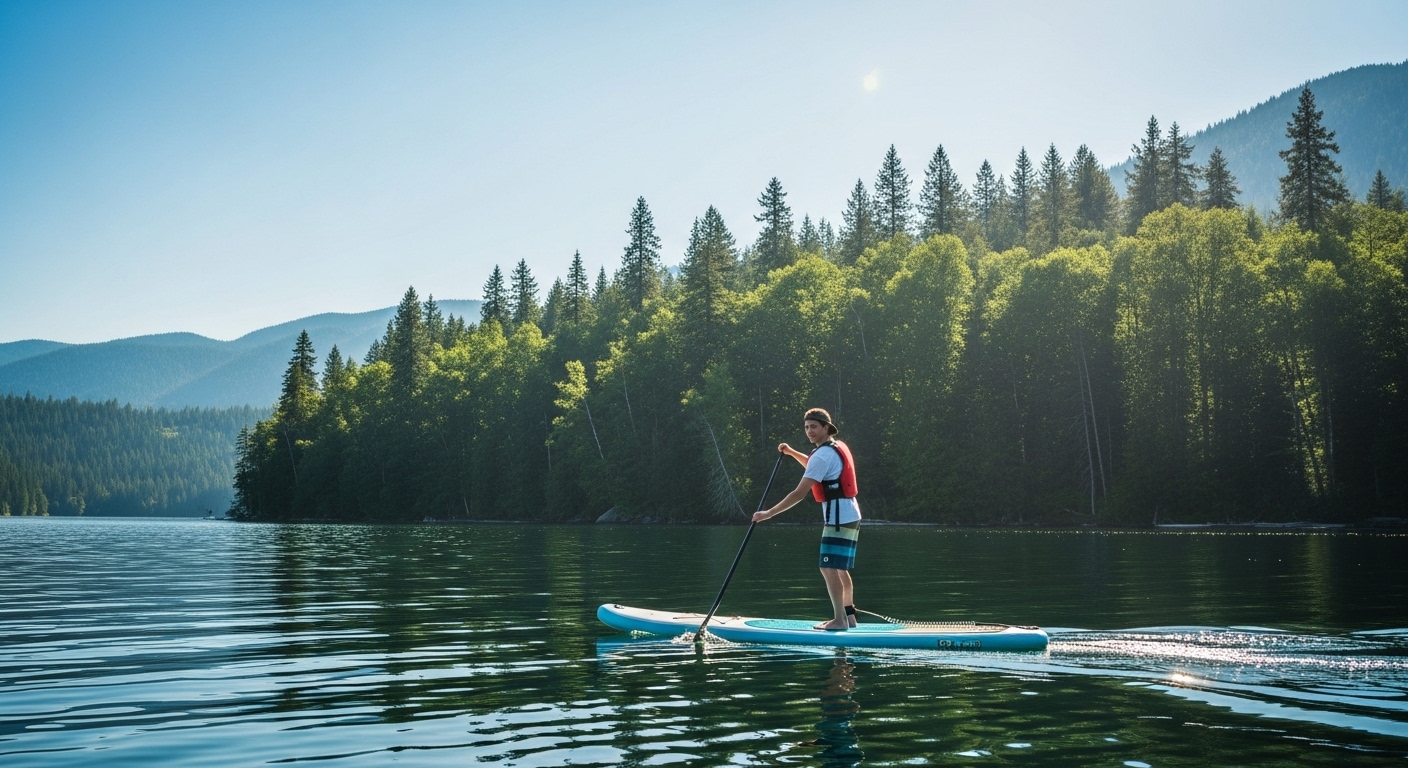
Paddleboarding 101: A Beginner's Guide to Stand-Up Paddleboarding
Your complete starting point for stand-up paddleboarding — no experience required.
Stand-up paddleboarding looks intimidating from the shore. A person standing on what appears to be a floating yoga mat, calmly gliding across the water while you’re still trying to figure out which end of the paddle is up. Here’s the truth: SUP is one of the most forgiving water sports you can pick up. Most beginners are standing and paddling within their first 20 minutes on the water. This guide covers everything — gear, technique, safety, and where to go first — so you can skip the guesswork and get out there.
What Is Stand-Up Paddleboarding?
Stand-up paddleboarding (SUP) is exactly what it sounds like: you stand on a large, buoyant board and use a long single-bladed paddle to move through the water. That’s the whole concept. It evolved from traditional Hawaiian surfing and outrigger paddling, and over the past two decades it has spread worldwide as a recreational sport, fitness activity, and even a racing discipline.
Unlike kayaking, where you sit low and use a double-bladed paddle, SUP gives you an elevated, upright position with a panoramic view of whatever water you’re on. That elevated vantage point is part of the appeal — you can see fish beneath you, watch wildlife from a quiet distance, and cover distance without feeling cooped up.
Want a deeper look at the gear itself? Check out what is a paddleboard for a full breakdown of board types, constructions, and how they differ from surf boards.
SUP works on flat lakes, rivers, bays, open ocean, and yes — waves, once you’re ready for them. For beginners, flat or mildly moving water is the ideal starting point, and that’s where we’ll focus throughout this guide.
The Gear You Actually Need
You don’t need a garage full of equipment to get started. Here’s the honest short list:
The Board
Your board is the foundation. Beginner boards are wide (31–34 inches), long (10–11 feet), and thick (4–6 inches) — all of which adds up to stability. The wider and thicker the board, the harder it is to tip. Don’t buy a narrow performance board for your first season. For most beginners, an inflatable SUP (iSUP) is the smart choice: it’s forgiving underfoot, easy to transport, stores in a backpack, and performs surprisingly well on flat water. Hard epoxy boards offer more glide but require a roof rack and more storage space.
The Paddle
A SUP paddle is longer than a canoe paddle and angled at the blade — that angle is intentional, it pulls water efficiently when you’re standing upright. A proper fit is roughly 6–10 inches taller than you. Adjustable aluminum paddles work fine for beginners; carbon fiber paddles are lighter and nicer but not necessary on day one.
The Leash
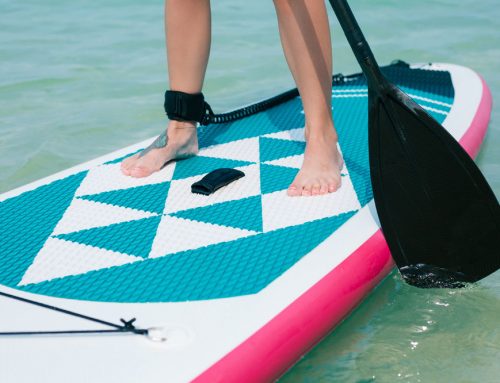
Non-negotiable. A leash attaches your ankle (or calf) to the board so that if you fall, your board stays within reach. On flat water, use a coiled leash so it doesn’t drag. On rivers with current, switch to a quick-release waist leash — a coiled ankle leash can become a hazard around underwater obstacles.
The PFD (Life Jacket)
In the United States, the Coast Guard classifies paddleboards as vessels, which means you are legally required to have a Coast Guard–approved personal flotation device accessible while on the water. Most paddlers wear an inflatable belt pack PFD — it stays out of the way until you need it. Check your local regulations, but carrying a PFD is both the law and the right call.
The Pump (For Inflatables)
If you go the inflatable route, you need a pump. Most iSUPs come with a hand pump; a dual-action pump (inflates on both the push and pull stroke) cuts inflation time in half. Electric pumps exist and are worth every penny if you paddle frequently. Inflate to the PSI listed on the board — usually 12–15 PSI for proper rigidity.
How to Choose a Beginner Board
With so many boards on the market, the choices can feel overwhelming. Here’s a simple framework for beginners:
Volume and weight capacity: Every board has a volume rating in liters. A good beginner rule is to aim for a board with a volume of at least 1.5–2 times your body weight in pounds (converted to liters). Manufacturers list a weight limit — stay well under it, not right at it. A board rated for your exact weight will sit lower in the water and feel tippy.
Width: Boards 32–34 inches wide are the stability sweet spot for most beginners. Narrower than 30 inches and you’ll be fighting for balance instead of learning technique.
Length: All-around beginner boards typically run 10 to 11 feet. Longer boards track straighter (hold a line better); shorter boards turn more easily. For general flat-water paddling, 10’6″ is a popular and practical beginner length.
Hard vs. inflatable: If you have easy water access and storage space, a hard board offers more glide and responsiveness. If you live in an apartment, own a sedan, or want to travel with your board, an inflatable is the more practical choice — and modern iSUPs perform well enough that many experienced paddlers prefer them.
We’ve tested and ranked the top picks — see our guide to the best beginner boards for current recommendations across price points.
Getting on the Water: Launch, Kneel, Stand
Your first time on a board follows a simple three-stage progression. Don’t rush the stages.
Stage 1 — Launch from shallow water
Carry your board into knee-deep water. Lay the paddle across the board in front of you. Climb on from the side at the center point of the board — there’s usually a carry handle there that marks the balance point. Get onto your knees, straddling the board. Pause here. Feel the board move beneath you. This is normal; you’re learning how it responds to your weight shifts.
Stage 2 — Paddle on your knees
Before standing, practice paddling from your knees. Hold the paddle with one hand on the T-grip handle and one hand on the shaft. Reach forward, plant the blade in the water, and pull back toward your ankle. Switch sides every few strokes. Get comfortable with the motion. Many beginners skip this step and regret it — kneeling is stable, forgiving, and a great way to build paddle muscle memory before adding balance to the equation.
Stage 3 — Stand up
When you’re ready, position your hands flat on the board on either side of your knees. Bring one foot up at a time to where your knees were, landing in an athletic stance: feet parallel, hip-width apart, toes pointing forward (not sideways like a surfer). Keep your knees slightly bent and your gaze on the horizon — not at your feet. Looking down shifts your weight forward and makes the board wobble. Stand up slowly, take a breath, and paddle.
You will fall. Everyone does. Fall away from the board if you can (not onto it), and always climb back on from the side at the center. For a full technique walkthrough, see our guide on how to paddleboard.
Basic Strokes and Turning
You only need three strokes to get around comfortably as a beginner:
The Forward Stroke
This is your workhorse. Reach forward with the blade fully submerged, pull back to your ankle, then exit the water cleanly. The power comes from your core and torso rotation — not just your arms. Keep your top arm (on the T-grip) pushing down and forward while your lower arm pulls back. Switch sides every 3–5 strokes to paddle in a straight line.
The Reverse Stroke
Plant the blade near your ankle and push it forward toward the nose of the board. This slows you down or, on one side only, helps spin the board. It’s your braking stroke and a key component of turning in tight spaces.
The Sweep Stroke
For turning while moving, reach the blade far forward and sweep it in a wide arc away from the board toward the tail. A forward sweep on your right turns the board left; a forward sweep on your left turns the board right. Combine a forward sweep on one side with a reverse sweep on the other and the board spins quickly in place — useful for navigating around obstacles or reversing direction.
Safety Basics Every Beginner Should Know
SUP is a low-risk sport when approached sensibly. These aren’t rules to memorize — they’re habits to build from day one.
- Always wear or carry your PFD. Belt-pack inflatables make this effortless. There is no excuse for being on open water without one accessible.
- Always use your leash. If you fall in cold water or a current grabs your board, a leash is the difference between a minor inconvenience and a serious emergency.
- Check the weather before you go. Wind is the beginner’s biggest enemy. Flat water at 8 a.m. can turn into 15-mph headwind chop by noon. Check a marine forecast (Windy.com is excellent), not just a general weather app. Aim for sub-10 mph wind days when you’re learning.
- Tell someone your plan. Where you’re putting in, where you’re going, when you expect to be back. Simple.
- Know your limits and paddle into the wind first. If you paddle downwind to start, you’ll have an exhausting upwind return. Launch into the wind so your easy paddle home is with the wind at your back.
- Cold water requires extra caution. Even on a warm day, water temperature below 60°F carries real hypothermia risk if you fall in. Dress for the water temperature, not the air temperature.
Where to Paddle First
Not all water is created equal for beginners. Here’s a hierarchy from easiest to more challenging:
Best: Small protected lakes and ponds. Minimal current, no boat traffic, easy shore access. This is the ideal learning environment. If you have a local lake or reservoir, that’s your classroom.
Good: Bays, inlets, and slow rivers. Calm bays with minimal boat traffic are excellent. Slow, wide rivers work well when the current is gentle — stay aware of where the current is taking you and plan your return trip. Avoid rivers with significant rapids until you’re experienced.
More challenging: Ocean, large lakes, fast rivers. Ocean paddling introduces waves, wind swell, and boat wakes. Large open lakes can generate surprising chop when wind picks up. Fast rivers require specific river SUP skills and different safety equipment. Work up to these gradually.
Wherever you go, check if there are designated swimming or paddling areas separate from motorboat traffic. Many popular spots have them. Boat wakes aren’t dangerous once you know how to handle them (turn to face the wake at a slight angle), but they’re disorienting for first-timers.
Your Next Steps After the Basics
Once you’re comfortable standing, paddling in a straight line, and turning, a whole range of SUP disciplines opens up:
SUP Yoga — flat-water yoga on a wide, stable board. Harder than land yoga in a very fun way.
SUP Touring — covering distance on flat water with a touring or race board. Meditative, great exercise, accessible to all fitness levels.
SUP Fishing — a growing segment. Wide, stable boards work well, and the elevated vantage point is genuinely useful for spotting fish.
SUP Surfing — riding waves on a shorter, more maneuverable board. A natural next chapter if you’re near ocean or lake swell.
SUP Racing — local races exist in most paddling communities and welcome all skill levels. A great way to meet other paddlers and push your fitness.
The progression is gradual and self-directed. Most paddlers spend their first season on flat water getting comfortable and never feel the urge to chase waves — and that’s a perfectly complete version of the sport. The goal is time on the water. Everything else follows from that.