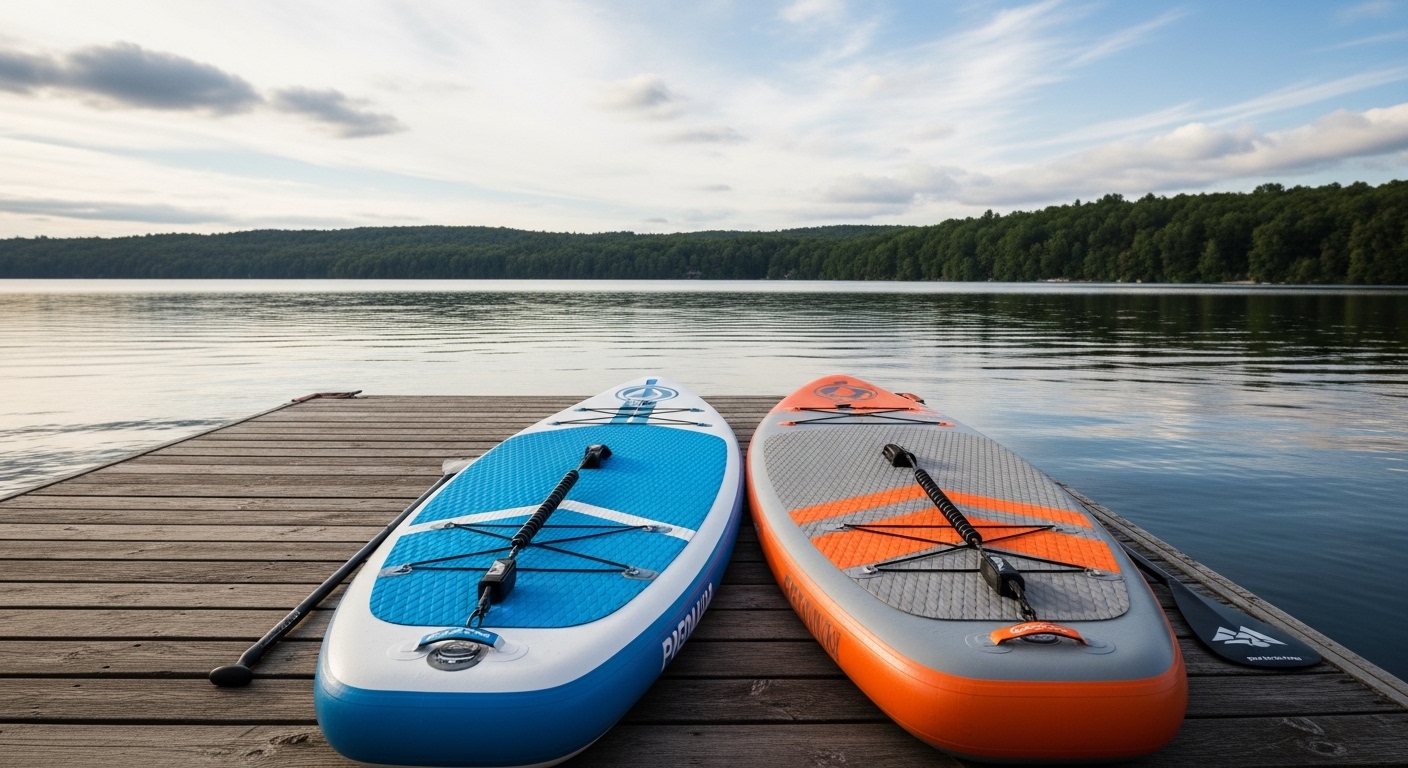
iRocker Paddleboard Vs Isle Paddleboard
iRocker Paddle Board vs ISLE Paddle Board
Two names come up constantly when shoppers start comparing mid-range inflatable SUPs: iRocker and ISLE. Both brands have been in the game long enough to earn real credibility, and both sit in the same price window. The honest answer is that neither is universally better — they make different trade-offs that suit different paddlers. This guide breaks down everything that matters so you can pick the right board without regret.
Brand Overviews: Who Makes These Boards?
iRocker launched in 2013 out of Jacksonville, Florida. Founder Steve Elder built the company into one of the fastest-growing paddle board brands in the country — it hit roughly $70 million in annual revenue by 2022 and earned an Ernst & Young Entrepreneur of the Year nod for the region. iRocker’s strategy has always been straightforward: deliver more board per dollar than the competition. They operate several sub-brands including Blackfin (premium), Nautical (entry-level), and Ultra (ultralight travel). Their core audience is beginners, recreational paddlers, and families who want durability and value without a steep learning curve.
ISLE (International Surf & Leisure Equipment) has even deeper roots. Marc Miller and Doug Pate founded the company in 2004 in San Diego, originally focused on hard boards. They moved into inflatables in 2013 and by 2017 had sold over 100,000 boards, making them one of the most established names in US paddle boarding. Solo Brands acquired ISLE in 2021. Their target buyer tends to be slightly more experience-curious — someone who wants a board that can convert to a kayak, handles choppy coastal water, and doesn’t weigh a ton when it’s time to carry it down the beach. ISLE is also a 1% For The Planet member, which resonates with their environmentally conscious customer base.
Both brands sit firmly in the “serious recreational” tier. Neither is a budget throwaway, and neither is a performance-racing specialist. That makes the head-to-head genuinely useful — you are comparing real competitors, not apples and oranges. For a broader look at where these two fit in the landscape, see our paddle board brand comparison.
Flagship Matchup: iRocker All-Around vs ISLE Pioneer
The clearest apples-to-apples comparison puts iRocker’s All-Around lineup against ISLE’s Pioneer 3. Both are 10’6″ all-around shapes aimed at recreational paddlers, yoga, flat water, and light coastal use. Here’s how they stack up on paper:
| Spec | iRocker All-Around / Cruiser 10’6″ | ISLE Pioneer 3 |
|---|---|---|
| Length | 10’6″ | 10’6″ |
| Width | 34″ | 34″ |
| Thickness | 6″ | 6″ |
| Board Weight | ~21–22 lbs | 19 lbs |
| Weight Capacity | 435 lbs | 285 lbs |
| Recommended PSI | Up to 15 PSI | 15–18 PSI |
| Warranty | 3 years | 5 years |
| Return Window | 45 days (no restocking fee) | 60 days (20% restocking fee) |
| Mid-2025 Price | ~$499–$529 (sale) | ~$695 |
On paper, iRocker wins on weight capacity and price. ISLE wins on weight, warranty length, and return window. The real differences live in how those numbers translate to water.
Construction and Stiffness: Two Different Philosophies
This is where the brands diverge most meaningfully. Understanding construction is the key to understanding why each board feels the way it does.
iRocker uses what they call Triple Layer Composite PVC — a knitted drop-stitch core wrapped in dual-layer fiber-reinforced PVC tarpaulin. More PVC mass means a heavier board, but it also means higher puncture resistance and a stiffer feel that is forgiving of imperfect inflation. If you pump an iRocker to 12 PSI instead of 15, it still feels reasonably solid underfoot. That matters a lot for beginners who may not own a quality pump gauge or simply don’t know to push to the recommended pressure.
ISLE takes a different route with their Airtech Prolite construction. Instead of stacking PVC layers, they use a woven (cross-woven) drop-stitch fabric core — the geometry of the weave itself resists flex better than a knitted core at equivalent PSI. The outer shell is a single layer of military-grade PVC, but ISLE bonds rails with their PowerFuse welded technology, which fuses the top deck, bottom, and side rails without glued seams. Glued seams are historically the failure point on inflatable SUPs; eliminating them improves long-term structural integrity and is a legitimate engineering advantage.
The catch: the Pioneer 3’s stiffness is PSI-sensitive. At 15 PSI it feels good; at 17–18 PSI it feels genuinely rigid. Inflate it to only 12 PSI and it will feel soft. That is fine for experienced paddlers who know their gear, but beginners may find iRocker’s more forgiving construction easier to manage day-to-day.
For a full breakdown of which inflatable SUPs hold up best across brand tiers, see our guide to the best inflatable paddle boards.
Stability, Weight Capacity, and Who Each Board Fits
At identical dimensions — 10’6″ x 34″ x 6″ — both boards offer similar baseline stability for an average-weight paddler. Width and thickness are the primary drivers of stability, and both boards share those numbers. The differences emerge at the extremes.
iRocker’s 435-pound weight capacity is exceptional for a recreational all-around board. That number is not a marketing figure — it reflects a genuinely robust construction. Heavier paddlers (over 220 lbs), tandem paddling with a child or dog, or anyone loading gear for a multi-day trip will find the iRocker handles load without noticeable flex. The Pioneer 3’s 285-pound limit is reasonable for solo use but leaves less margin.
ISLE’s 19-pound board weight, on the other hand, is a real advantage for anyone who cares about portability. Two pounds may sound trivial until you have carried a board half a mile to the water and back. ISLE also includes a wheeled backpack in the box, which partially offsets the carry challenge for either board. But on weight alone, ISLE wins.
ISLE’s Pioneer 3 also features the ISLE-LINK system — perimeter webbing loops rated to 100+ kg along both rails — which integrates with their kayak conversion seat (sold separately) and cargo attachments. If paddling in touring or hybrid mode appeals to you, the Pioneer 3’s accessory ecosystem is broader.
Included Kit and Paddle Quality
Both brands include a full kit in the box, which is one of the reasons each justifies its price point.
iRocker bundles a 3-piece adjustable carbon paddle, a coiled safety leash, their MAGTITE magnetic snap-lock fin system (three fins that cannot be dropped overboard — a genuinely clever design), a manual pump, carry strap, and repair kit. The MAGTITE system is a practical differentiator; losing a fin mid-session is a real frustration, and iRocker solved it cleanly.
ISLE Pioneer 3 includes the ISLE Remix 3-piece adjustable paddle (carbon fiber shaft with a nylon blade), a 3 Series Wheelie Backpack with both wheels and backpack straps, a single-action hand pump, a rigid touring center fin with a split/folding fin box for tighter board roll-up, a 6-foot coil leash, sticker pack, and repair kit.
On paddle quality, both are comparable mid-grade carbon paddles — light enough to use all day, not so light that they feel fragile. The wheeled backpack from ISLE is a meaningful convenience upgrade over a standard carry bag. iRocker’s MAGTITE fin system is a meaningful convenience upgrade over a standard fin box. These are genuine differentiators, not filler specs.
Warranty and Customer Support: The Honest Picture
Warranty matters more for inflatable SUPs than for almost any other outdoor gear category, because seam failures and valve issues happen — and how a brand handles them defines the real ownership experience.
iRocker covers the board for 3 years and accessories for 1 year. Their return policy is 45 days with no restocking fee; you pay $30 flat for return shipping. On Trustpilot, iRocker has thousands of reviews that skew positive, with many satisfied warranty replacement stories. However, a notable minority reports slow response times and warranty claim denials, and a 2022 recall of certain Blackfin models (for seam separation due to substandard glue in a specific production window) is part of the brand’s public record. The recall was handled proactively with free replacement boards, which is the right response, but it’s worth knowing.
ISLE covers boards for 5 years and offers a 60-day return window — both stronger terms on paper. ISLE’s BBB rating is an F, which sounds alarming but reflects failure to respond to a small number of formal complaints filed through BBB’s platform specifically; it does not necessarily represent typical service quality. Individual customer service stories in the review community are often very positive, with reports of warranty replacements initiated within hours and offers of full store credit or free upgrades. ISLE’s 20% restocking fee on returns is a genuine drawback compared to iRocker’s no-fee policy.
Net assessment: iRocker’s return terms are friendlier if you change your mind. ISLE’s warranty duration is better if you plan to keep the board long-term. Neither brand has a flawless support record; both have resolved serious issues for most customers who pushed for resolution.
See our full iRocker brand review for a deeper look at their support track record and product lineup.
Price and Value: What Your Money Actually Buys
As of mid-2025, the iRocker All-Around 11′ is running around $529 on sale, and the 10’6″ Cruiser sits near $499. The ISLE Pioneer 3 is $695 and holds its price more consistently — ISLE does not run frequent deep discounts the way iRocker does during seasonal sales windows.
That $160–200 gap is not trivial. At $499–529, iRocker delivers a board with higher weight capacity, a proven durable construction, and a comprehensive kit. The Pioneer 3 at $695 delivers a lighter board, a longer warranty, a more refined kayak conversion system, and a construction approach (PowerFuse welded rails) that arguably holds up better over many years of use.
If you are a first-time buyer who is not sure how often you will paddle, iRocker’s lower price and easier learning curve make it the less risky choice. If you are confident you will use the board regularly for five-plus years, the Pioneer 3’s lighter weight, longer warranty, and welded rail construction start to justify the premium. Design aesthetics also diverge — ISLE’s colorways tend toward cleaner, more minimal graphics; iRocker leans into bolder patterns. That is entirely subjective but worth noting for buyers who will look at their board in the garage for years.
Verdict: Choose iRocker If… / Choose ISLE If…
Choose iRocker if:
- You want the best weight capacity in this price range (435 lbs handles heavier paddlers, passengers, and loaded gear)
- You are a beginner who wants a board that is forgiving of imperfect inflation and technique
- Budget matters — the $150–200 price gap is real and iRocker delivers excellent value
- You want the no-fuss return policy (no restocking fee, flat $30 shipping)
- You like the MAGTITE magnetic fin system (genuinely useful on the water)
Choose ISLE Pioneer 3 if:
- Weight and portability are priorities — 19 lbs vs 21–22 lbs adds up on long carries
- You plan to own the board for many years and want the 5-year warranty coverage
- You want the SUP-to-kayak conversion option (ISLE-LINK system + Cloud Kayak Seat)
- You paddle at higher PSI consistently and want the stiffness benefits of the woven drop-stitch core and welded rails
- Environmental impact matters to you (ISLE’s 1% For The Planet commitment)
Both boards are genuinely good choices in the mid-range inflatable SUP market. The iRocker is the better pick for most first-time buyers and anyone prioritizing value or high weight capacity. The ISLE Pioneer 3 earns its premium for regular paddlers who want a lighter, longer-warranted board with a more versatile accessory ecosystem. Neither brand is going to disappoint a recreational paddler who pumps it up properly and gets on the water.