How to Paddleboard With Your Dog
Paddle boarding with your dog is one of the best things you can do on the water — once you both know what you're doing.
Look, your dog already thinks you hung the moon. Bringing them onto a paddleboard is just the next logical step. But unlike fetch or a car ride, SUPing with your pup takes a little prep. The good news? Most dogs catch on faster than you’d expect — especially if you make it feel like an adventure instead of an ordeal. This guide walks you through everything: picking the right board, training your dog from zero, the gear that actually matters, and how to read your dog’s comfort so every session ends with both of you wanting to go back.
Choosing a Dog-Friendly Paddleboard
Not every board is built for a four-legged co-pilot. Before you worry about training your dog, make sure your equipment is actually up to the job.
Width matters most. Go wider than you think you need — 34 inches minimum, ideally 35 or 36. Width is stability, and stability is everything when a golden retriever decides to lean over the nose to sniff a passing duck. Narrow race boards and slim touring shapes are a bad idea here.
Full-length deck pad. This is non-negotiable. A small tail pad leaves your dog standing on a slippery fiberglass or PVC surface — they’ll scramble, panic, and bail. A full soft deck pad gives their paws real traction and is far more comfortable for long floats. It also takes abuse better than bare board material.
Capacity. Add your dog’s weight to yours, then add 30–40 pounds as a buffer. A board that’s maxed out sits low and feels sluggish — it also rocks more. Give yourself room. Most all-around inflatable boards in the 10’6″–11′ range handle 250–350 lbs, which covers most people-plus-dog combos just fine.
Inflatables vs. hard boards. Inflatable SUPs win for dog duty. They’re softer underfoot, more forgiving when a dog scrambles to reposition, easier to store, and cheaper to repair. Hard boards are faster and more responsive, but a dog digging in for purchase on a fiberglass deck is a recipe for scratches and a stressed dog. If you want the full breakdown on top picks, the best paddle boards for dogs guide covers the field.
✓ 34″+ wide ✓ Full deck pad ✓ Enough weight capacity ✓ Inflatable preferred
Training Your Dog — Start on Dry Land
The single biggest mistake people make is driving to a lake, plopping their dog on a board, and expecting magic. Some dogs roll with it. Most do not. A little land training changes everything.
Step 1: Board on the ground. Put the inflated board flat in your yard or living room. Let your dog sniff it, walk on it, and lie on it on their own terms. Don’t rush. Put a few treats on the deck pad and walk away. You want the board to be boring and good, not novel and scary.
Step 2: Reward all four paws on board. Once your dog steps on without hesitation, start marking that behavior — a clicker or a calm “yes” works great. Treats every time all four paws are on deck. Practice getting on and off, both from standing and from a sit. This builds the muscle memory they’ll use at the water’s edge.
Step 3: Motion and rocking. Gently press the edges of the board to create a slight wobble while your dog is on it. Not dramatic — just enough so they feel the give and learn to balance. Keep treats coming. Keep your energy calm. If your dog bails, no drama — just invite them back on.
Step 4: Commands. Two commands matter most: place (or whatever you use for “go to your spot”) and stay. If your dog will hold a stay on a rocking surface on land, they’ll hold it on water. Spend a week on these before you ever get near the lake.
Step 5: Short first sessions on water. First time out, keep it to 10–15 minutes max. Launch in calm, shallow water. Let your dog get on from the bank, then you get on. Paddle slowly. Stay close to shore. Quit before your dog gets anxious. End every session on a high note — even if that means cutting it short.
Doggy Life Jackets — Not Optional
Yes, your dog can probably swim. And yes, they should still wear a life jacket on the paddleboard. Here’s why: fatigue, surprise, and cold water are the real risks. If your dog goes in unexpectedly and panics — or you both go in — a PFD keeps them buoyant without effort while you sort yourself out.
Look for a dog PFD with a top handle. That grab loop lets you haul your dog back onto the board from the water in one motion — critical if they go off the nose and the current is pulling them. It also helps when launching and landing.
Fit matters: the vest should be snug without restricting movement, and it should sit just behind the front legs. Let your dog wear it around the house a few times before water day so it doesn’t feel alien.
• Top handle for easy rescue lifts
• Bright color for visibility
• Proper fit (not swimming in it, not pinching)
• Tested in shallow water before open water
Where Your Dog Should Sit (and What to Do About Claws)
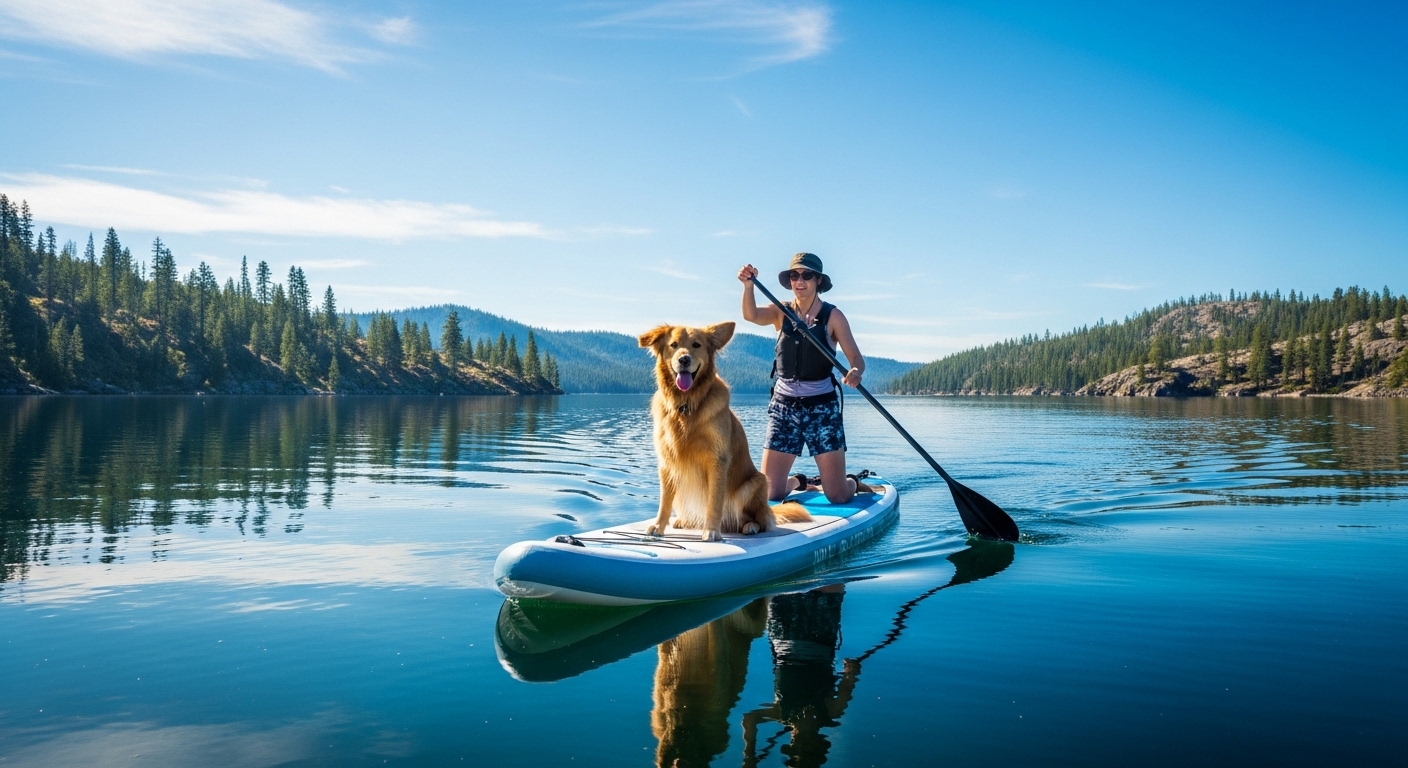
Position: nose or middle, not tail. Most dogs naturally want to stand at the nose of the board — let them. It puts their weight where it has the least effect on steering and gives them a great view. Some dogs prefer to sit near your feet in the middle. Both work. Avoid letting them sit at the very tail — their weight there makes the board plow and turns every stroke into a fight.
Once your dog finds their spot and holds it reliably, paddling gets genuinely easy. You’ll both settle into a rhythm. Many dogs lie down after the first five minutes once they relax — which is the goal.
Claws and deck pads. Dog nails will mark up a deck pad over time — that’s just life. But you can minimize damage and protect your dog’s grip at the same time. Keep nails trimmed short. Rough nails catch on soft deck material and can tear it, but more importantly, sharp nails make dogs less stable — they dig in and slip rather than gripping with their pads. A quick nail trim before the season and monthly upkeep makes a real difference.
If you have a short-haired dog with naturally smooth paw pads, some paddlers use thin neoprene dog boots for extra grip on slick surfaces — though most dogs adjust without them once they’ve spent a few sessions on the water.
Getting On and Off the Board Safely
Launching and landing are the two moments most likely to go sideways — literally. Build a routine and stick to it every time.
Launching. Start in water shallow enough that the board doesn’t float yet. Get your dog on first, then you kneel on and paddle into deeper water before standing. This keeps the board stable during the most chaotic part of the process. If your dog jumps off during launch — and they will, at least once — stay calm, bring the board back in, and try again.
Standing up. Once you’re past the shallows, stand slowly. Don’t pop up fast. Keep your knees soft. Your dog will shift their weight to compensate — they’re better at this than you’d expect. Talk to them quietly while you stand.
Landing. Reverse the process. Kneel before you hit the shallows, paddle in, let your dog off first. Some dogs will jump off into the water when they see shore — that’s fine, just be ready for it so you don’t get destabilized.
If you’re considering bringing two people plus a dog, a wider board helps enormously — check out the best 2-person paddle boards for shapes that handle the extra weight distribution.
Reading Your Dog's Comfort — and Knowing When to Stop
Dogs communicate constantly. The problem is we’re usually too focused on paddling to notice. Learning to read your dog on the water is what separates good sessions from stressful ones.
Signs your dog is comfortable: relaxed ears, soft panting, curiosity (looking around, sniffing the air), lying down, tail wagging. A dog who lies down mid-session is a happy dog.
Signs your dog is stressed: tense body, low tail, yawning repeatedly, whining, constant shifting, trying to jump off. If you see these, paddle in and end the session — don’t push through it hoping they’ll settle. They won’t, and you’ll make the association worse.
Heat and hydration. Dogs on water get hot fast — the reflection off the surface is intense. Bring fresh water and a collapsible bowl. Plan sessions for morning or evening in summer. A dog ramp or floating platform can help if your dog wants to swim to cool off mid-session; it gives them an easy way back on without you having to haul them.
Keep sessions short at first — 15 to 20 minutes — and build from there. Most dogs are happy for 45 minutes to an hour once they’re comfortable. Quit while they’re still enjoying it.
Safety Basics — Yours and Theirs
A few rules that aren’t worth bending:
Calm water only, especially early on. Choppy water, boat wakes, and wind make every challenge harder. Flat, protected water — a calm lake, a gentle bay, a slow-moving river — is where you want to start and where most dog SUP sessions should happen anyway. It’s more fun for both of you.
Wear your own PFD and use a leash. You know this. But it’s worth saying: if your dog goes in and you go in chasing them, a leash keeps the board close and a life jacket keeps you buoyant. Use a coiled leash attached to your ankle or calf — not your waist, which makes falling over risky.
Don’t go out alone your first few times. Paddle with another person nearby. Getting your dog back on the board solo while treading water is genuinely hard the first time it happens. Having a friend close makes the whole learning curve safer.
For the fundamentals of paddling technique and water safety — separate from the dog-specific stuff — how to paddleboard is worth a read before your first session.
• Dog PFD: on • Your PFD: on • Ankle leash: clipped
• Water: packed • Calm water: confirmed • Phone: dry bag
Paddle boarding with your dog isn’t a complicated sport. It’s mostly just showing up, being patient with the learning curve, and paying attention to an animal who trusts you completely. Get those things right and you’ll have a paddling partner for years.