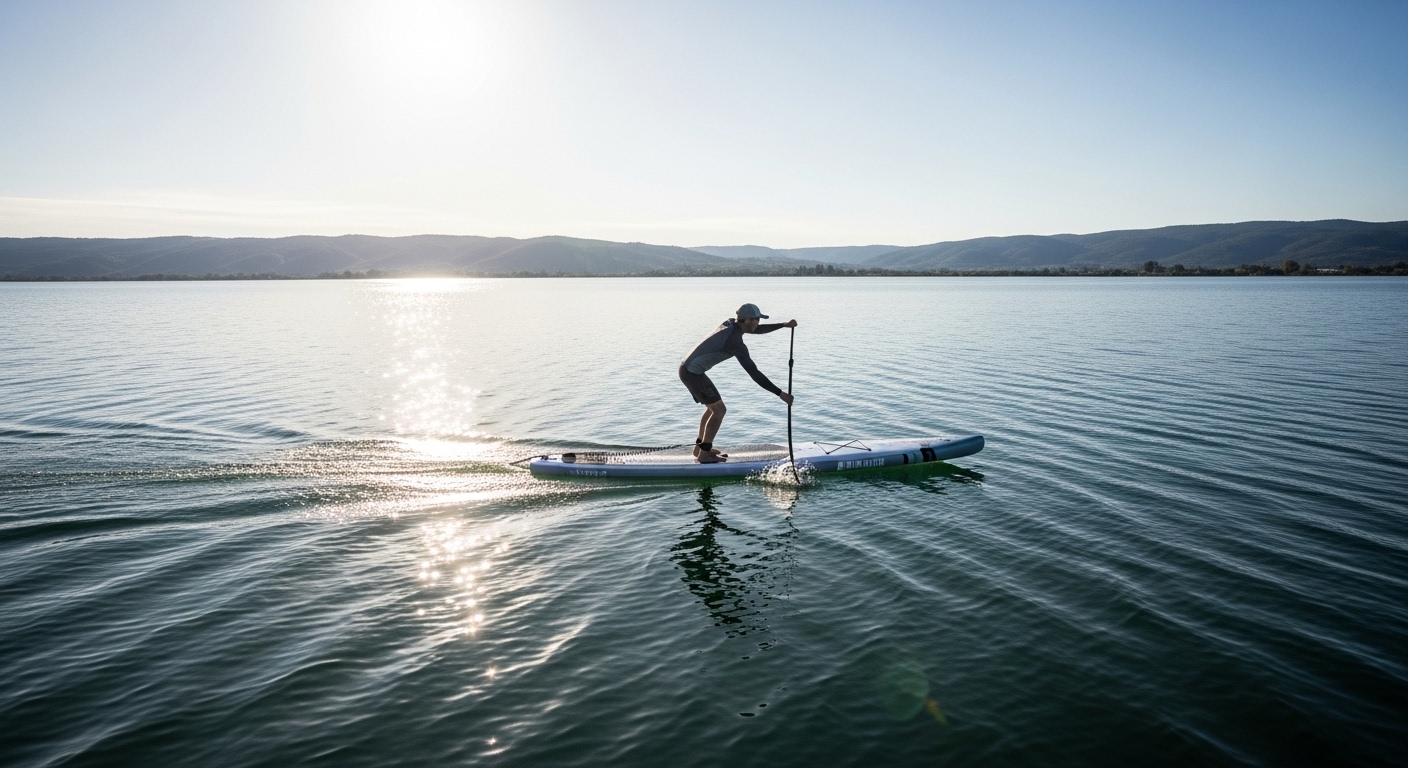
How Fast Can You Paddleboard A Stand-Up Paddleboard?
Most people are surprised by just how wide the speed range is on a paddle board — from a lazy 2 mph drift to elite racers cracking 8 mph in downwind conditions. Here's the honest breakdown.
Stand-up paddle boarding covers a huge range of speeds depending on who’s paddling, what board they’re on, and what conditions they’re dealing with. This guide cuts through the vague answers you’ll find elsewhere and gives you real numbers — along with the specific factors that push those numbers up or down.
Typical Paddle Board Speeds: Real Numbers by Rider Type
Let’s start with the numbers most people actually want. Here’s a straightforward breakdown of realistic speeds across different skill and fitness levels:
- Casual cruising (beginner to recreational): 2–3 mph. This is the pace you’ll naturally settle into when you’re learning, sightseeing, or just enjoying a relaxed paddle on flat water. It requires minimal effort and is perfectly sustainable for hours.
- Fit recreational paddler: 3–4 mph. Someone who paddles regularly and has decent technique will sit comfortably in this range. You’re moving with purpose but not working hard.
- Touring pace: 4–5 mph. Paddlers using a dedicated touring paddle board and solid technique can hold this speed for extended distances. It takes real effort to maintain but isn’t a sprint.
- Competitive / race training: 5–7 mph. At this level, board choice, paddle technique, fitness, and race-specific training all converge. Sprint bursts in this range are achievable for experienced paddlers; sustaining it requires serious conditioning.
- Elite racers and downwind conditions: 7–9+ mph. Top-level competitors on technical race boards — especially in downwind runs where they’re catching swell — can push well beyond 7 mph. Some GPS-tracked downwind runs have recorded speeds above 10 mph in optimal conditions.
What Actually Affects Your Speed on a Paddle Board
Speed on a SUP isn’t just about how hard you paddle. Several factors interact to set your realistic ceiling — and some of them matter more than most people realize.
Board Length and Shape
Longer boards are faster boards, full stop. A longer waterline means less drag per unit of speed. A 14-foot race board will always outrun an 11-foot all-around board given equal effort. Shape matters too — a narrow, pointed nose cuts through water more efficiently than a wide, rounded one.
Hull Type: Displacement vs. Planing
Displacement hulls have a pointed, v-shaped nose that parts water and pushes it to the sides. They’re more efficient at speed and are standard on touring and race boards. Planing hulls are flat — they’re designed to ride on top of the water at lower speeds and are common on all-around and surf-style boards. For raw speed over distance, a displacement hull wins every time. Understanding the difference between types of paddle boards is the first step toward matching your board to your goals.
Board Width
Width and stability trade off directly against speed. A 32-inch-wide board is far more stable than a 24-inch race board, but that extra width creates more drag. Narrower boards reward good balance with lower resistance. Most beginners need the extra stability; experienced paddlers can go narrower.
Your Fitness and Conditioning
Paddle boarding is a full-body workout. Your core drives the stroke, your legs provide a stable platform, and your arms and back deliver power. Paddlers who train consistently — especially with cross-training like swimming or rowing — hit higher sustained speeds because they can maintain proper form without fatigue breaking it down.
Paddle Technique
Poor technique caps your speed regardless of fitness. The most common mistakes — short strokes, bent elbows, paddling behind the hips — bleed energy rather than converting it into forward motion. A technically efficient stroke at moderate effort will outperform a sloppy power-stroke every time.
Wind and Current
A headwind of even 10 mph will dramatically slow you down — you’re pushing both your board and your body through the air. A tailwind, conversely, can add 1–2 mph to your pace with no extra effort. Current works the same way: paddling with a mild river current feels effortless; paddling against it is a grinding workout. Conditions matter enormously.
Water Conditions
Flat, calm water is fastest. Chop, swell, and waves force constant micro-corrections that interrupt your stroke rhythm and waste energy. Open-ocean conditions require more stabilization work, which comes at a speed cost.
Rider Weight
A heavier paddler pushes the board deeper into the water, increasing wetted surface area and drag. This doesn’t mean heavier riders can’t be fast — they can — but it does mean the board choice matters more. A board that’s too small or narrow for your weight will sit low and be sluggish; choosing a correctly sized board largely neutralizes this factor.
All-Around vs. Touring vs. Race Boards: A Real Speed Comparison
The board you’re on sets the ceiling for what’s possible. Here’s how the three main categories compare in practice:
All-Around Boards (10–11.5 ft, 30–34 in wide)
These are the most popular boards on the water, and for good reason — they’re stable, versatile, and handle everything from flatwater to mild surf. But their wide, shorter shape makes them the slowest category. Most paddlers on an all-around board will cruise at 2.5–3.5 mph. That’s completely fine for recreation, yoga, and casual touring, but if speed is a priority, you’ll outgrow an all-around board quickly.
Touring Boards (12–14 ft, 27–30 in wide)
Built specifically for covering distance efficiently, touring boards combine a displacement hull, extra length, and reduced width to deliver meaningful speed gains. A paddler who hits 3.5 mph on an all-around board will often see 4.5–5 mph on a comparable touring board with the same effort. These are the workhorses of long-distance paddling. Check our full best touring paddle boards guide if you’re ready to make the switch.
Race Boards (12.6–14 ft, 21–26 in wide)
Race boards are engineered around one thing: speed. They’re narrow, stiff, and require real balance skill to ride. In skilled hands, they’ll hit 6–8+ mph. In untrained hands, they’re challenging to stay on. Most paddlers who train for SUP racing spend months developing the balance and technique to use a race board effectively before they see its speed benefits.
How to Paddle Faster: Technique, Cadence, and Board Choice
Want to push your speed up? These are the changes that actually move the needle:
Fix Your Stroke Before You Push Harder
The single biggest speed gain most paddlers can make costs nothing: improve technique. A proper SUP stroke plants the blade fully in the water ahead of your feet, pulls straight back (not curved), and exits before it passes your hips. Keeping your arms straighter and rotating from the core — not just pulling with your arms — doubles the power behind each stroke. If you’re new to the mechanics, our beginner’s guide to paddle boarding covers stroke fundamentals in detail.
Increase Stroke Cadence
Speed is a product of power and cadence. Many recreational paddlers take long, slow strokes. Experiment with a slightly shorter, faster stroke rate — you may find your speed increases without feeling like more work. Elite racers typically paddle at 55–70 strokes per minute; recreational paddlers often paddle in the 35–45 range. Even moving to 50 strokes per minute with good form can noticeably lift your pace.
Upgrade Your Board
If you’ve been paddling on an all-around board for a year or more and your technique is solid, a longer touring board is likely the single biggest speed upgrade available to you. The shape difference matters more than most people expect. Browse our best paddle boards roundup for vetted options at every price point.
Upgrade Your Paddle
A carbon fiber paddle weighs roughly half what a cheap aluminum paddle weighs. Over hundreds of strokes, that weight difference accumulates into real fatigue — and fatigued paddlers slow down. A properly sized, lightweight paddle also allows better technique. It’s a worthwhile investment once you’re paddling regularly.
Train Your Body for Paddling
Core strength, rotational power, and aerobic endurance all directly limit sustained paddling speed. Adding specific exercises — dead bugs, pallof presses, swimming, rowing — builds the fitness base that lets you hold good form at higher intensities for longer.
Realistic Expectations: What Should You Actually Aim For?
Here’s the honest framing most articles skip: the speed range that matters is your speed range, not a racer’s.
If you’re paddling for fitness and fun, hitting 3–4 mph consistently on flat water means you’re paddling well. You’re moving efficiently, getting a solid workout, and covering real distance. There’s no prize for obsessing over race-level speed if that’s not your goal.
If you want to improve — and most paddlers do, naturally — track your pace over familiar routes over time. GPS watch apps like Garmin Connect or even a phone in a waterproof case will give you reliable speed data. Small technique improvements compound surprisingly fast. Many paddlers add 0.5–1 mph to their average speed within the first six months of consistent practice just from technique refinement alone.
If you’re considering SUP racing or long-distance touring events, set a realistic 12-month goal. Moving from a 3.5 mph recreational pace to a 5 mph touring pace is a reasonable goal with consistent practice and a board upgrade. Moving from 5 mph to race-competitive speeds takes years of dedicated training and significant board investment — which is completely achievable, but worth going in clear-eyed about.
Conditions That Can Push Your Speed Higher (or Lower)
Beyond your board and technique, environmental conditions play a significant role in what speed is possible on any given day.
Downwind Paddling
Paddling downwind in light swell is the ultimate speed hack. Experienced paddlers learn to “catch” runs on small waves, letting the energy of moving water carry them forward. In optimal downwind conditions with even modest swell, skilled paddlers on touring or race boards regularly average speeds that would be impossible on flat water. It’s a specific skill that takes practice to develop, but it’s why open-ocean downwind runs are one of the most exciting formats in SUP racing.
Current Assistance
River paddlers know this well. Paddling with a 1–2 mph current behind you effectively adds that speed to your average with no extra effort. On a point-to-point river tour, this is a significant advantage. Going upstream, that same current works against you — expect to work noticeably harder to maintain normal pace.
Flat Calm vs. Choppy Water
There’s a reason race courses are held on protected flatwater when possible. Chop disrupts your stroke rhythm, forces balance corrections, and creates resistance against the hull. In choppy ocean conditions, the same paddler on the same board may be 1–1.5 mph slower than on a glassy lake. Wind-driven chop is one of the most common reasons paddlers feel sluggish on days when conditions look deceptively mild from shore.
Cold Water
Cold water is denser than warm water, which technically creates very slightly more resistance. In practice, the bigger speed impact from cold water is the paddler: cold muscles don’t fire as efficiently, and the instinct to paddle more cautiously in cold conditions (rightfully, for safety) often reduces effort output. Dress appropriately for the water temperature and your speed will reflect your actual fitness rather than your body holding back.
Summary: Speed Benchmarks at a Glance
To tie everything together, here’s a clean reference for where you fit and what’s realistically achievable:
- Beginner / casual: 2–3 mph on any board
- Regular recreational paddler: 3–4 mph on an all-around board
- Fit paddler on a touring board: 4–5.5 mph
- Trained racer in training: 5–7 mph
- Elite racer / downwind conditions: 7–10+ mph
Board choice, technique, fitness, and conditions each contribute meaningfully to where in that range you land. The good news: all of them are improvable. If you’re just getting started, our how to paddle board guide will give you the fundamentals that underpin everything else. And when you’re ready to choose a board that matches your speed ambitions, our best paddle boards guide has current, vetted picks at every level.