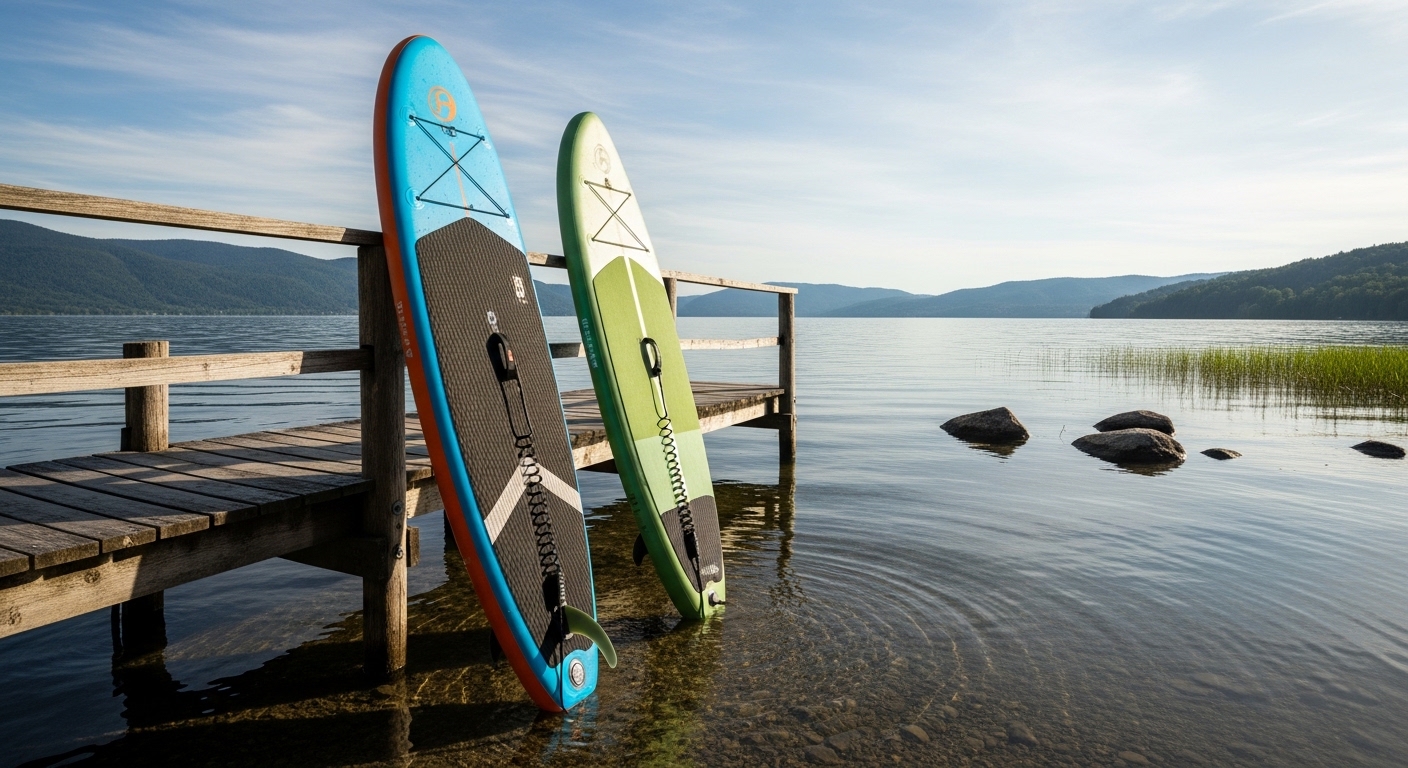
Fiberglass Vs Inflatable Paddleboard
Two very different boards. One right answer for you.
Walk into any paddle shop and you will see two camps: sleek hard fiberglass boards stacked on racks, and rolled-up inflatables stuffed into backpacks by the door. Both float, both paddle, and both have devoted fans — but they are built on completely different design philosophies. This guide breaks down every dimension that matters so you can stop second-guessing and start paddling.
What We Mean by Fiberglass and Inflatable
A fiberglass paddle board (sometimes called a hard board or epoxy board) is a rigid shell — typically a foam core wrapped in fiberglass cloth and sealed with epoxy resin. Higher-end versions add carbon fiber layers for extra stiffness and lighter weight. The result is a board that holds a precise shape at all times.
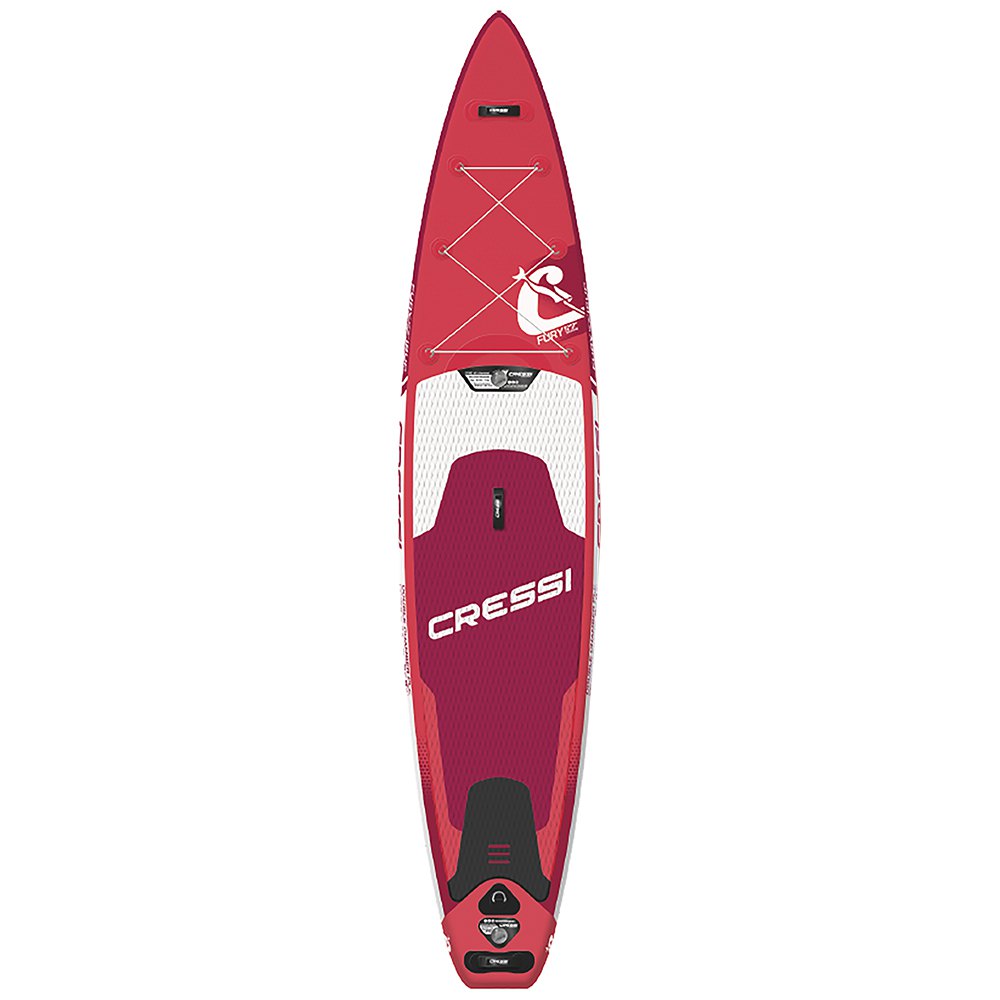
An inflatable paddle board (iSUP) is built from military-grade PVC with thousands of drop-stitch fibers connecting the top and bottom skins. When you pump it to the correct pressure (usually 12–15 PSI), those fibers pull taut and the board becomes surprisingly rigid. Unpumped, it rolls into a bag about the size of a large duffel. See our PSI guide for proper inflation technique.
Both styles come in touring, all-around, surf, and racing shapes. The distinction is construction material and rigidity — not intended use.
Performance and Glide: Where Physics Decides
This is where fiberglass wins, clearly and consistently. A hard board is rigid by definition — its rocker, rails, and outline are locked in place from the moment it leaves the mold. That means every paddle stroke transfers cleanly into forward motion with no flex-based energy loss.
Inflatables flex slightly underfoot, especially near the tail and nose. At 12–15 PSI that flex is minor, but it is real. Independent glide tests consistently show fiberglass boards traveling 5–10% farther per stroke at equivalent effort. Over a two-hour tour that adds up. For racing, surf, or anyone chasing maximum speed, fiberglass is the only conversation worth having.
That said, most recreational paddlers — people out for a Saturday morning cruise, doing yoga, or exploring calm bays — will never feel the performance gap. A quality inflatable at proper PSI paddles better than a cheap hard board every day of the week.
For a deeper look at the performance differences, see our inflatable vs hard comparison deep dive.
Durability: Dings vs Punctures
Both board types are durable — just in different ways, against different threats.
Fiberglass boards are rigid, so they crack and ding when they take a hard hit. Rocky launches, parking lot drops, and clumsy car racks are the main killers. A ding lets water into the foam core and starts a slow rot. The fix is straightforward — ding repair epoxy and a few minutes of work — but it has to happen promptly. Left wet, a core can delaminate and the repair gets expensive fast.
Inflatables bounce off the same rocks that would crack a hard board. The PVC shell is thick and tough. The failure mode is puncture rather than cracking, and punctures are less common than most beginners fear. When they do happen, the repair kit included with most boards — a patch, glue, and five minutes — handles the vast majority of cases.
The real durability risk for inflatables is heat. A fully inflated board left in a hot car or baking in direct sun can over-pressurize and stress the seams. Always release a little air before storing in heat.
Side-by-Side Comparison
| Factor | Fiberglass / Hard Board | Inflatable iSUP |
|---|---|---|
| Glide & Speed | Excellent — best available | Good — 5–10% behind hard at same effort |
| Rigidity | Fully rigid, always | Rigid at 12–15 PSI, minor flex |
| Impact Resistance | Cracks and dings on hard hits | Bounces off rocks; rare punctures |
| Weight | 17–30 lbs typical | 18–28 lbs (plus bag + pump) |
| Portability | Needs roof rack or truck | Fits in a backpack; airlines approved |
| Storage | Needs garage, shed, or wall mount | Rolls up; fits in a closet or trunk |
| Price Range | $700–$3,000+ | $300–$1,500 |
| Stability | Stable; hull shape locks in | Slightly softer underfoot; forgiving |
| Learning Curve | Slightly less forgiving of falls | Softer, more forgiving for beginners |
| Maintenance | Ding repair; annual wax/deck check | Rinse PVC; valve check; store deflated or slightly inflated |
| Lifespan | 10–20+ years with care | 5–10 years typical; seam-dependent |
| Resale Value | Strong — premium brands hold value | Moderate — drops faster |
Browse our picks in both categories at best paddle boards to see how specific models stack up.
Weight, Portability, and Storage
On paper the weight difference between a fiberglass board and an inflatable is often small — both typically land between 17 and 28 pounds depending on size and construction. The real difference is form factor.
A fiberglass board is always 10–11 feet long. It needs a vehicle with roof rails or a truck bed. You cannot check it on a plane (well, you can, but the shipping fees are brutal). Getting it from the car to the water means carrying a large, awkward, easily dinged object through parking lots and down stairs.
An inflatable rolls into a bag roughly the size of a large backpack. You carry it over your shoulder. You check it as oversized luggage on most airlines for standard fees. You store it under a bed or in a hall closet. For anyone living in an apartment, traveling frequently, or paddling in multiple locations, this difference is not trivial — it is the deciding factor.
The tradeoff is setup time. Inflating an iSUP with a hand pump takes 10–15 minutes. An electric pump cuts that to 5–7 minutes. A hard board is ready the moment it hits the water.
Price, Stability, Lifespan, and Resale
Price: Entry-level inflatables from reputable brands start around $300–$400. A decent fiberglass all-around board starts around $700 and climbs to $3,000 or more for race-ready carbon builds. You get more board per dollar with an inflatable at the entry and mid level.
Stability: Fiberglass boards have a fixed hull shape — their stability characteristics are locked in. Inflatables have slightly softer rails underfoot, which some beginners find more forgiving when they wobble. Neither type has an inherent stability advantage; width and volume are what actually determine how stable a board feels, regardless of material.
Learning curve: Both types work for beginners. Inflatables are slightly more forgiving because the deck has a little give and falls feel softer. Hard boards feel faster and more responsive, which some beginners prefer and others find intimidating. Our best inflatable paddle boards guide highlights models that are especially beginner-friendly.
Maintenance: Fiberglass boards need occasional ding repair and should be kept out of direct sun when not in use (UV fades the finish and can warp cheaper constructions). Inflatables need a fresh-water rinse after saltwater use, valve checks once a season, and proper deflation before storage. Neither type is high-maintenance if you follow basic habits.
Lifespan: A quality fiberglass board, properly cared for, lasts 15–20 years or more. Inflatables typically see 5–10 years of solid use before seams or PVC start to fatigue — longer with quality construction and careful storage.
Resale: Premium fiberglass brands (Starboard, NSP, Naish) hold resale value well — a used board from a respected brand still commands 40–60% of retail after several years. Inflatables depreciate faster; a three-year-old iSUP typically sells for 20–35% of its original price. If you think you will upgrade in a few years, a quality hard board may be a better investment.
Who Should Buy Which Board
Buy fiberglass if you:
- Race, surf, or want maximum glide and speed
- Paddle the same local spot most of the time
- Have a garage, truck, or roof rack for transport
- Plan to keep the board long-term and care about resale
- Want the ultimate on-water experience and are willing to pay for it
Buy an inflatable if you:
- Live in an apartment or have no dedicated board storage
- Travel frequently or want to fly with your board
- Paddle rocky rivers, tidal flats, or rough launches where dings are likely
- Are buying your first board and aren’t sure how often you will paddle
- Want solid performance at a lower entry price
- Have kids or dogs on the board regularly