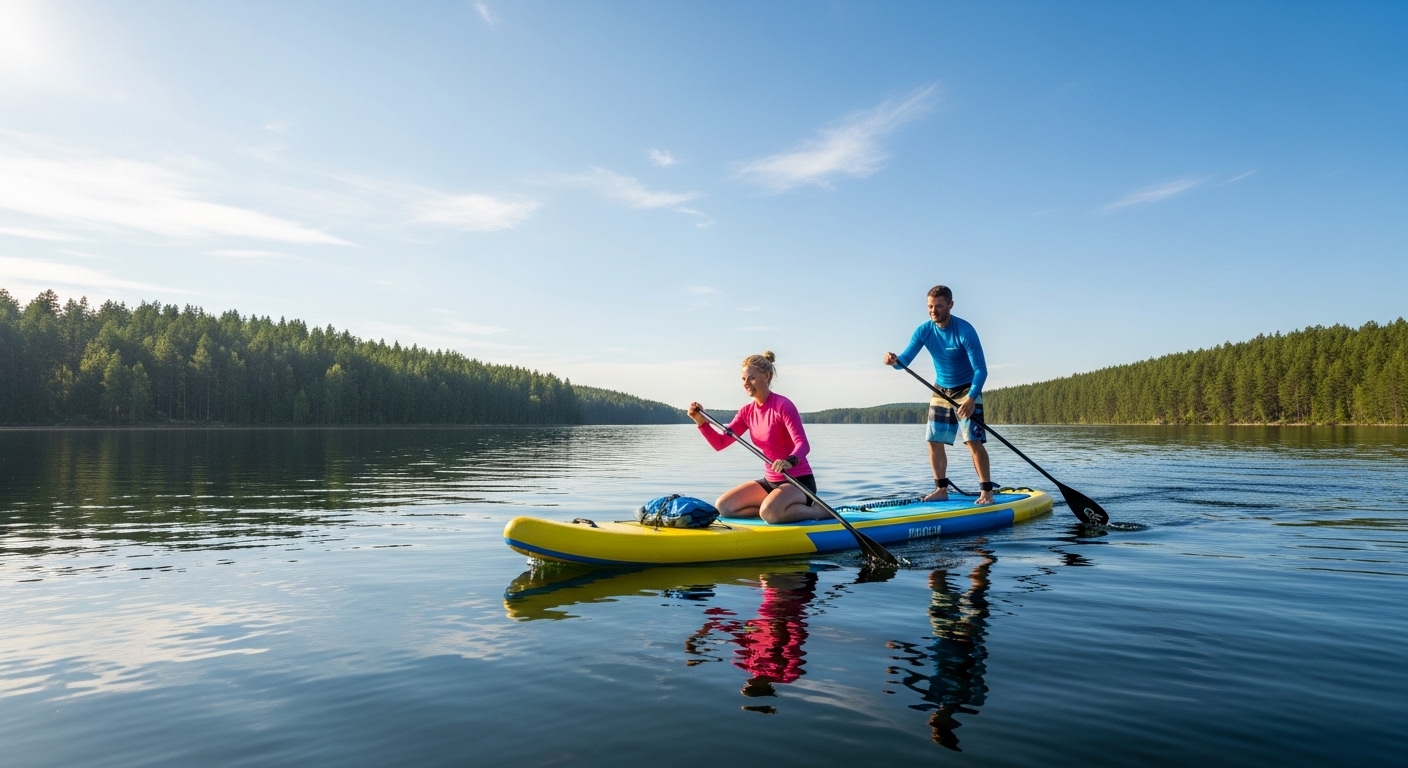
Buying A 2 Person Inflatable Paddleboard
A tandem inflatable paddle board sounds perfect on paper. Here's the full picture — what works, what doesn't, and how to pick the right one.
Sharing a paddle board with your partner, your kid, or your dog is genuinely fun — when you have the right board under you. The problem is that most boards marketed as “2-person” are vague about what that actually means in practice. This guide breaks down what a tandem iSUP really is, who it works for, and what specs actually matter so you don’t end up with a board that’s awkward to carry and frustrating to paddle.
What Is a 2-Person Inflatable Paddle Board?
A 2-person inflatable paddle board — also called a tandem iSUP — is a longer, wider, higher-capacity inflatable board designed to support two riders at once. Standard solo iSUPs run 10 to 11 feet long and hold 250 to 300 pounds. Tandem boards typically stretch to 12 feet or longer, reach 34 inches or more in width, and carry 400 pounds or more.
The “inflatable” part matters here. Drop-stitch PVC construction makes these boards rigid enough to paddle seriously when inflated to 12–15 PSI, but they roll up into a backpack when you’re done. For a big board that two people need to haul to the water, that portability is a genuine advantage — you’re not strapping a 12-foot hard board to a roof rack.
What these boards are not is a magic solution for two adults who want to paddle with equal effort at equal speed. We’ll get into that reality in a moment.
Who Actually Benefits from a Tandem iSUP?
Before you buy, be honest about how you’ll use the board. Tandem iSUPs genuinely shine in a few specific situations:
- Parent and young child: This is the sweet spot. A parent paddles while a kid sits or stands in front. The board is stable, the child has plenty of room, and nobody argues about who paddles harder.
- Paddler and dog: If your dog is 50-plus pounds, a standard solo board is cramped and tippy. A wide tandem gives the dog space to settle without throwing off your balance. Dogs generally park themselves near the nose and stop caring about the rest.
- Couples on calm water: Two adults can both paddle a tandem — one at the front, one at the rear — on flat, calm water. It works best when both paddlers have similar experience and can coordinate strokes. It’s genuinely enjoyable for leisurely paddling. It is not efficient for covering distance quickly.
- One paddler who wants a seriously stable platform: A 34-inch-wide tandem board used solo is almost impossible to fall off. If you’re new to SUP, returning after an injury, or want to do yoga on the water, the extra width and volume make a big difference.
- Gear haulers and campers: Multi-day SUP camping trips require space for dry bags, food, and gear. A tandem board’s length and extra D-rings make it far more practical than a loaded-up solo board.
Check our picks for best 2-person paddle boards if you want to skip ahead to tested recommendations.
The Honest Reality of Tandem Paddling
Here’s what the marketing photos don’t show: two adults paddling a tandem iSUP at the same time is harder than it looks. The physics are straightforward — two people paddling from different positions create uneven thrust, the board wants to spin, and you spend a surprising amount of energy correcting course instead of moving forward.
This doesn’t mean it’s not worth doing. It means you need to set expectations correctly before you drop $600 or more on a board.
Weight is the other honest conversation. A quality tandem iSUP with a pump, two paddles, a leash, and a bag weighs 30 to 40 pounds. That’s manageable for one person over a short carry, but if your launch point is a quarter mile from the parking lot, two people sharing the load is almost a requirement. The rolled-up board fits in a large backpack, but the bag is bulky and the pump adds awkward weight.
If weight capacity is a primary concern — for a heavier solo paddler or two adults over 350 pounds combined — read our guide to high-capacity boards for more detail on what the specs actually mean in water.
Key Specs to Look For
Not all boards marketed as tandem are actually built for it. Here’s what separates a genuine tandem iSUP from an oversized solo board with creative marketing:
- Length 12 feet or longer: Two adults standing need at least 12 feet of board. Anything shorter and you’re fighting for foot placement. Boards at 14 feet give you more stability and glide at the cost of harder transport logistics.
- Width 34 inches or more: Width is your primary stability factor. At 34 inches, two adults can stand side by side on flat water without feeling like they’re negotiating a balance beam. Some tandem boards reach 36 inches for extra margin.
- Weight capacity 400 pounds or more: This is the non-negotiable number. Add up both paddlers, their gear, any dog, water bottles, and safety equipment. Two average adults with basic gear land around 380 to 420 pounds. A board rated at 350 pounds is not a tandem board regardless of what the listing says.
- Multiple carry handles: A board this size needs at least three carry handles — nose, center, and tail. Some boards add side handles. You’ll thank yourself on every single carry.
- Extra D-rings: D-rings let you attach gear bags, dry boxes, coolers, and leashes. A tandem board with only two or three D-rings is underbuilt for the job. Look for six or more.
- Dual fin setup or wide center fin: Tracking is harder on a wide board. A three-fin setup (thruster) or a large single center fin gives you directional stability that helps when two paddlers are creating uneven thrust.
- Dual attachment points for paddles: If both paddlers want to secure their paddles while the other person is in the water, you need two attachment points. Many tandem boards include this; many do not.
For a broader comparison of the inflatable board category before you narrow down to tandem models, our best inflatable paddle boards guide covers the fundamentals in detail.
Using a Tandem Board as a Solo Board
One of the underrated advantages of a tandem iSUP is how well most of them work as a solo board. The extra width creates a platform that is nearly impossible to fall off, which makes tandem boards a legitimate option for beginners who want to build confidence, older paddlers who want a lower-consequence board, or anyone who does SUP yoga.
The tradeoff is speed and maneuverability. A 14-foot tandem board used solo does not turn easily and does not glide efficiently with a single paddler. You’re moving more water and more board than you need to. For leisure paddling on calm water, this is completely fine. For paddling into any kind of current or covering real distance, it becomes work.
If you anticipate using the board solo 70 percent of the time with occasional tandem sessions, size down to a wide solo board in the 11’6″ to 12′ range and accept the tandem compromise. If you’ll genuinely use it for two riders at least half the time, the full tandem board is worth the extra size and weight.
Top Features That Separate Good Tandem Boards from Mediocre Ones
Once you’ve confirmed the core specs, these features separate boards worth owning from boards worth skipping:
- Military-grade PVC with double-layer construction: Single-layer boards exist at lower price points. They are lighter, which sounds appealing, until they develop soft spots or delaminate after a season. Double-layer or fusion construction costs more and lasts longer — on a board this size, that matters.
- High-pressure rating (12–15 PSI): Higher pressure equals more rigidity equals better paddling performance. A tandem board that inflates to only 10 PSI will feel soft and slow under load. Confirm the board’s maximum rated PSI before buying.
- Included dual-action pump or electric pump compatibility: Inflating a large tandem board with a single-action pump takes forever and genuinely wears you out before you even hit the water. A dual-action pump or a 12V electric pump connection is worth prioritizing.
- Non-slip deck pad covering most of the board: Two people moving around a wet board need grip. Deck pads that cover only the center of the board leave the nose and tail area slippery. Full-length or near-full-length traction pads are significantly safer for tandem use.
- Included or compatible paddle options: Many tandem kits include two paddles. Verify the paddles are adjustable to the correct height for both paddlers. Cheap included paddles are often the weakest part of an otherwise solid kit.