Advice For Fishing While Standing On A Paddleboard
Paddle board fishing puts you in water a boat can't reach — silently, cheaply, and with a rod in your hand.
Fishing from a paddleboard sounds like a novelty until you sneak into a back-cove at dawn, drop a lure three feet from a feeding bass, and watch the water explode. SUP fishing is not a gimmick — it is one of the most effective and affordable ways to chase fish in shallow, vegetation-choked, or pressure-heavy water. This guide covers everything from picking the right board to landing a fish without going overboard.
Why Paddle Board Fishing Works So Well
The case for SUP fishing comes down to three hard advantages: stealth, access, and cost.
Stealth. A paddleboard glides across the surface with almost no noise and zero engine vibration. Fish that blow up at the sound of a trolling motor will hold their position when you drift in on a SUP. In clear, shallow water this is not a small edge — it is the difference between fish that feed and fish that scatter.
Shallow-water access. Most fishing SUPs draw four to six inches of water. That gets you into flooded grass flats, tidal creeks, lily-pad fields, and back-of-the-cove pockets that are simply unreachable by any propeller-driven craft. Redfish, bass, crappie, and pike all use shallow structure that boats push fish out of. A SUP lets you work that water undisturbed.
Cost. A quality fishing kayak runs $900–$1,800. A fishing-grade SUP in the same performance class costs roughly the same or less, but it doubles as a fitness board, a yoga platform, and a family lake toy. You are not buying a single-use piece of gear.
Choosing the Right Fishing SUP
Not every paddleboard is a fishing platform. A 10-foot all-around board designed for wave riding will have you swimming more than fishing. Here is what actually matters for SUP fishing.
Width — aim for 34 inches or more. Width is stability. A 32-inch board is fine for touring; a 34-to-36-inch board is where most anglers feel confident standing, casting, and fighting fish. If you are new to SUP or plan to fish rough water, go wider. Some dedicated fishing boards run 36–38 inches.
Length — 10’6″ to 12′. Longer boards track straighter and carry more weight, which matters when you add a cooler, tackle crate, and a day’s worth of water. Boards under 10 feet are maneuverable but tippy under load.
Weight capacity — match your real-world kit weight. Subtract your body weight from the board’s rated capacity, and what is left needs to cover your gear. Add your tackle, cooler, anchor, and safety kit before you commit to a board. For heavier anglers or anglers who carry a lot of gear, check out options in our guide to high-capacity boards.
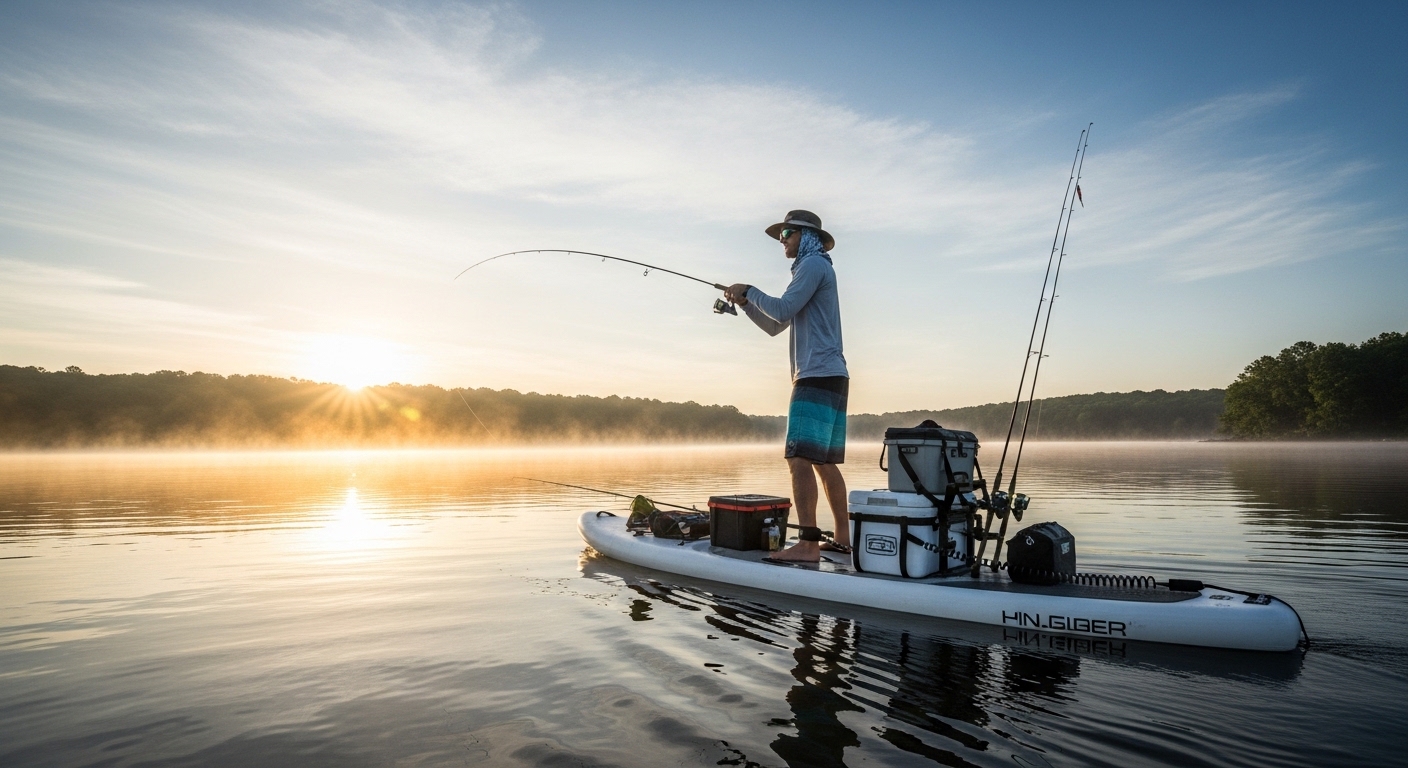
Deck hardware. Purpose-built fishing SUPs come with molded-in D-rings, bungee cargo nets, rod holder inserts, and sometimes a center console or tackle storage hatch. These are not luxury features — they determine how practical your rigging will be. Our roundup of the best fishing paddle boards covers the top picks across price ranges.
Inflatable vs. hard. Inflatable fishing SUPs dominate the category because they are easy to transport, more forgiving on impact, and surprisingly rigid at 15 PSI. A well-made inflatable from a reputable brand fishes every bit as well as a comparable hard board. The BOTE HD Aero is one of the most popular inflatable fishing platforms on the market and a good benchmark for what the category can do.
Rigging Your Fishing SUP
A bare board is just a platform. The right rigging turns it into a functional fishing machine. Keep it simple the first season — add gear as you identify gaps.
Rod holders. Flush-mount rod holders screw or clip into your board’s accessory rails or D-rings. Two holders is a practical minimum — one for your primary rod, one for a backup or a landing net. Angle them forward so you can reach them while standing at center.
Tackle crate or cooler. A milk-crate-style tackle box lashed to the rear bungee area keeps your terminal tackle, pliers, and lures organized and within reach. Pair it with a soft-sided cooler strapped to the front bungee area for fish and drinks. Keep both secured tight — a loose cooler shifts your balance at the worst moment.
Anchor system. Drifting is fine for covering water, but when you find fish you need to hold position. A folding grapnel anchor with 30 to 50 feet of light cord does the job. Store the cord in a small bag to prevent tangles. Clip the anchor line to a D-ring at the nose or tail, not at your waist.
Paddle holder. When a fish hits, you need both hands. A bungee clip or Velcro paddle holder on the rail keeps your paddle from floating away while you fight. This is cheap insurance — get one.
Fish finder. A compact kayak-style fish finder mounted on a RAM arm at the front of the board is surprisingly effective. Lowrance and Garmin both make units sized for human-powered watercraft. You will not use it every trip, but in new water it saves hours of blind searching.
For a deeper look at what to add to your setup, our paddle board accessories guide covers the full ecosystem.
Casting and Fighting Fish from a SUP
Standing on a floating platform while casting and fighting fish requires adjustments, but nothing you cannot dial in quickly.
Stance. Your feet should be shoulder-width apart, centered over the carrying handle, and slightly staggered (dominant foot back). Bent knees act as shock absorbers. When a fish hits, drop your center of gravity — do not lock your knees out.
Casting. Long overhead casts amplify upper-body rotation, which rocks the board. Start with shorter, controlled casts and focus on keeping your lower body quiet. Sidearm and roll casts are more board-friendly and still reach the targets you need to hit. As your balance improves, your casting distance will follow.
Fighting fish. When a fish runs, it will try to pull you off balance. Point the rod toward the fish and let the drag work rather than muscling against the run. Step back slightly if the pull comes from in front of you. For bigger fish — anything that might take a long run — widen your stance before the fight starts.
Landing fish. Landing from a standing position is manageable with a net. Lipped fish (bass, pike) can be lip-landed by kneeling on the board once you have the fish close. Kneeling also helps if the board has been rocking during a long fight — it buys you a stability reset without losing the fish.
Catch and release. Keep the fish in the water alongside the board as much as possible. A quick hook removal at water level, a photo if you want one, and a gentle release takes seconds. Fighting a fish to exhaustion and then holding it out of the water for photos is unnecessary on a SUP — you are already at water level, use it.
Safety on the Water
SUP fishing adds gear, distraction, and task-loading to an activity that already demands balance and water awareness. Take safety seriously from day one.
PFD — wear it, do not clip it. U.S. Coast Guard regulations require a wearable life jacket be on board for any person over 13. For fishing SUPs specifically, wear an inflatable belt-pack PFD that does not interfere with casting. If you fall in heavily loaded water or get tangled in line, a clipped-on PFD does nothing.
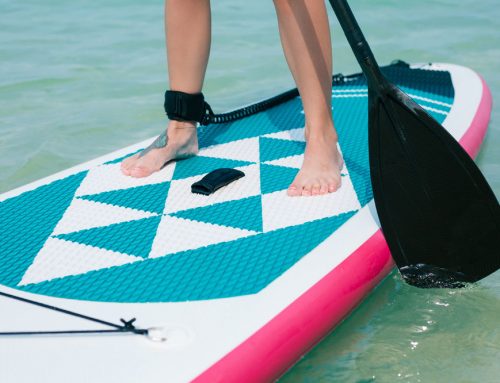
Leash. A coiled or straight leash connecting your ankle or calf to the board is non-negotiable. If you fall, the board becomes your flotation device and your rescue signal. In moving water use a quick-release leash. In flatwater, any standard SUP leash works.
Weather window. Check wind forecasts before launching, not just the temperature. Wind above 15 mph turns a fishing SUP session into a survival paddle. On open water, afternoon thunderstorms build quickly — have a bail-out time and stick to it. Flatwater and protected bays are the safest fishing environments for SUP anglers.
Sun and hydration. You are standing on a reflective surface for hours. UV exposure compounds fast on water. Wear sun-protective clothing, use reef-safe sunscreen, and carry more water than you think you need.
Tell someone. Before every session — even familiar water — tell someone where you are launching, where you plan to fish, and when you expect to return. It costs nothing and could save your life.
Beginner Tips for Your First SUP Fishing Trip
The first few sessions are about building confidence on the board, not catching fish. Go in with that mindset and you will learn faster.
Start on calm, warm, shallow water. A protected cove, a small pond, or a flat stretch of slow river gives you margin for error. Cold water plus wind plus a first-time SUP experience is a bad combination.
Bring only what you need. Your first session — bring two rods max and a small tackle bag. A fully loaded board is harder to balance and harder to manage when something goes wrong. Add gear as your balance improves.
Practice falling in. Before you start fishing, deliberately step off the back of the board in shallow water. Know what falling feels like, how to climb back on, and where your gear ends up. A controlled drill in two feet of water is infinitely better than an uncontrolled discovery in six.
Fish early. Wind and boat traffic both increase as the day heats up. A 6 a.m. launch gets you the calmest water, the most active fish, and the most forgiving conditions while your skills are still developing.
Fish from your knees if you need to. There is no pride at stake. Kneeling lowers your center of gravity and dramatically improves stability. Many experienced SUP anglers kneel when fishing tight to structure, making precise casts, or fighting large fish. Do what keeps you on the board and fishing.
Best Places to Fish from a Paddleboard
The SUP’s greatest advantage is water access, so choose locations that reward that advantage.
Shallow flats and grass beds. Redfish, snook, flounder, and bonefish use shallow coastal flats that go dry at low tide. A SUP lets you work these areas at any tide with zero disturbance. This is arguably the single best environment for SUP fishing.
Backwater creeks and tidal channels. Small tidal creeks that feed larger bays hold concentrations of fish on tidal movement. Most are too shallow and too narrow for any motorized boat. A SUP fits everywhere.
Freshwater ponds and small lakes. Farm ponds, urban retention lakes, and small recreational lakes are all pressure-free or nearly so. Bass, crappie, and bluegill in these environments have rarely seen a lure. Your stealth advantage is enormous.
River flats and backwater eddies. Wade-fishing rivers from a SUP combines the mobility of floating with the sight-fishing angle of wading. Work current seams and structure edges for trout, smallmouth, and pike.
Mangrove edges and structure. Snook, tarpon, and jacks use mangrove root systems that are completely inaccessible by boat. A SUP can be paddled right up to the root line and held in position with a push pole or anchor while you work the shadows.
Frequently Asked Questions
What size paddleboard is best for fishing?
Is paddle board fishing hard to learn?
Do I need a special paddleboard for fishing, or will any board work?
What safety gear do I need for SUP fishing?
Can you fish standing up on a paddleboard the whole time?
Best fishing boards →BOTE HD Aero review →Heavy-rider boards →Paddle board accessories →