6 Reasons For Paddleboarding At Night
Paddleboarding after dark sounds like a wild idea — until you try it once and realize it might be the best paddle of your life.
There’s a version of your favorite lake or bay that most paddlers never see. The boat traffic dies down, the air cools off, and the surface of the water goes glass-flat. Stars come out. If you’re lucky, the water itself starts to glow. Night paddle boarding is a genuinely different experience — quieter, cooler, and more rewarding than almost anything you’ll do on the water in broad daylight. But it comes with real responsibilities. The USCG has specific requirements for paddling after sunset, and skipping them puts you in danger and potentially in legal trouble. This guide covers both sides: the six reasons you’ll want to go, and exactly how to do it safely and legally.
Reason 1: The Water Is Dramatically Calmer
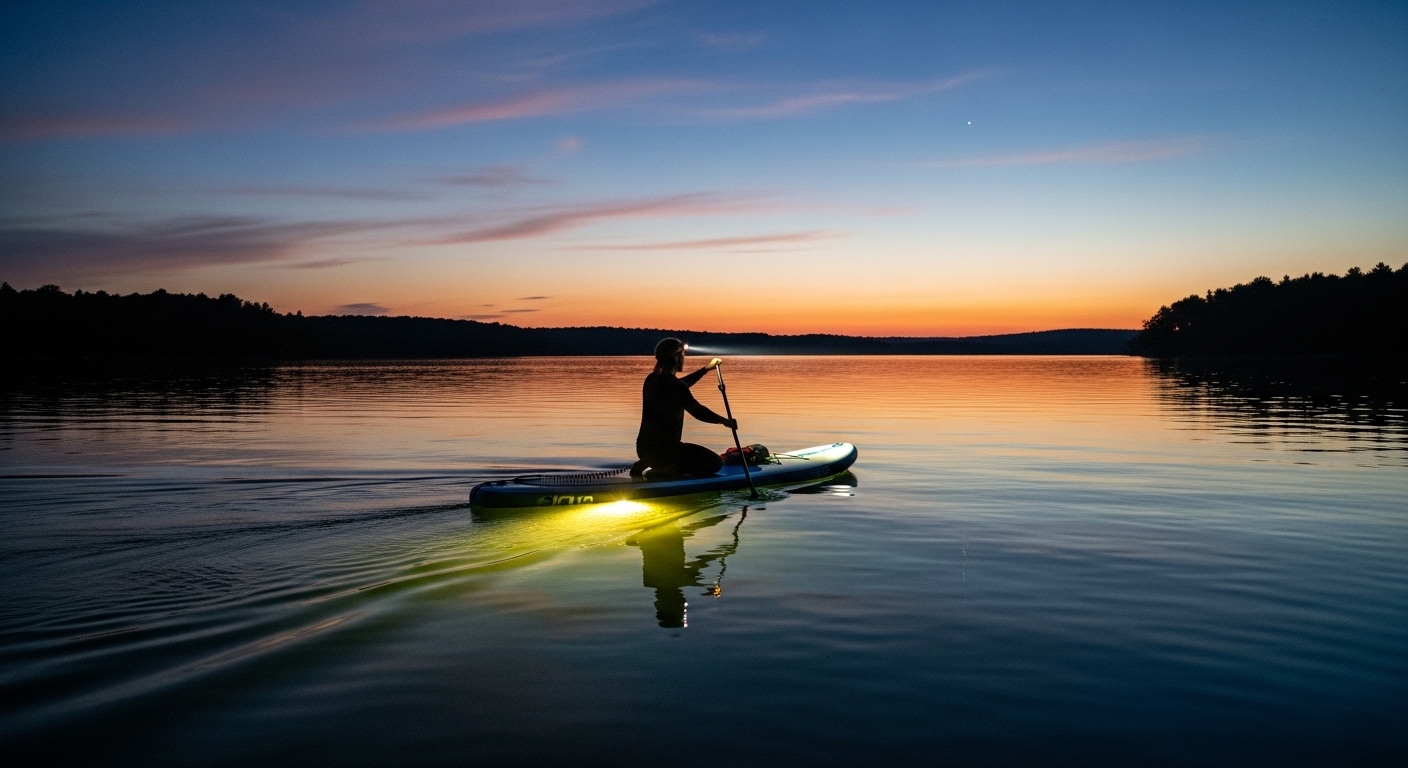
Wind is the enemy of a smooth paddle. By early evening, onshore breezes typically die off as the land cools. By full dark, many lakes, bays, and protected coastal areas sit almost completely still. That glassy, mirror-flat surface makes paddling easier, faster, and more meditative than anything you get during peak afternoon hours. You can hear your fin cutting the water. You can hear yourself breathe. If you’ve ever struggled with chop or whitecaps on a windy afternoon session, night paddling on calm water feels almost unfair — in the best possible way.
Reason 2: You Escape the Heat
Summer daytime paddling in the South, Southwest, or anywhere with serious sun means battling UV exposure, heat exhaustion risk, and a paddle that stops being fun around hour two. Night changes everything. Temperatures drop, the sun is gone, and you can push your distance and pace without cooking. For paddlers who live in hot climates, night sessions aren’t just a novelty — they’re often the only practical way to get a quality workout between June and September. Bring a light layer for the paddle back when temps drop further; it’s a good problem to have.
Reason 3: Bioluminescence (Nature's Greatest Light Show)
In coastal areas from San Diego Bay to the Indian River Lagoon in Florida, certain seasons bring bioluminescent plankton to the water. Paddle through it at night and your fin, your paddle strokes, and the bow wave of your board all glow electric blue-green. It sounds like something out of a nature documentary — it is something out of a nature documentary, and you can do it yourself. Kayakers have known about bioluminescence tours for years. SUP is an even better platform because you’re standing right above the water, looking straight down into the glow. Check local conditions and seasonal reports for your region; peak bioluminescence varies by location and water temperature.
Reason 4: Stars Without Light Pollution
Most of us live surrounded by enough artificial light that we rarely see a genuinely dark sky. Get on the water after dark, away from marinas and parking lots, and you’re in one of the darkest spots you’ll find near civilization. Lying flat on your board and looking up at a clear sky — even for five minutes — hits differently on the water. There’s no trail, no campsite, no overlook. Just you, the board, and several thousand miles of uninterrupted sky. New moon nights are best; check a moon phase calendar and plan around it for the clearest views.
Reason 5: Absolute Solitude (No Crowds, No Wake)
Popular paddling spots on a Saturday afternoon can feel like a water park. Same spot at 9 PM on a Tuesday? You might have the entire stretch of water to yourself. No jet skis, no rental kayakers zigzagging across your line, no motorboat wakes to navigate. Night paddling is self-selecting: most people never try it, which means the few who do get rewarded with an experience that feels private and unhurried. If you’ve been frustrated by how crowded your local launch has gotten, night sessions solve that completely.
Reason 6: Wildlife Behaves Completely Differently
Herons fish at night. Dolphins are active in low-light hours in many coastal areas. Manatees surface quietly near warm-water outflows after dark. Bats hunt insects over the water at dusk. The wildlife you encounter on a night paddle is often entirely different from the daytime crowd — and because the water is quiet and you’re moving slowly, you get closer and spook them less. Bring a small, low-lumen red-light headlamp if you want to observe without blinding yourself or startling animals.
Night Paddle Boarding Safety and Legal Requirements
Under U.S. federal law, any paddleboard operated on navigable waters after sunset is required to carry:
- A white light visible in all directions (360 degrees). This can be a lantern, a clip-on LED light, or a waterproof flashlight you can show to approaching vessels. It must be visible from at least two miles away. This is not optional — it is a legal requirement enforced by the Coast Guard and state marine patrol agencies.
- A sound-producing device. A whistle meets the requirement. Keep it on your PFD, not in your dry bag.
Beyond the legal baseline, the following gear and practices make night paddle boarding genuinely safe:
- LED board lights or glow strips. Deck-mounted LED strips or underwater lights make you visible to other boaters from a distance and make your board easier to locate if you fall. These go beyond the USCG minimum and are strongly recommended. Check the full list of recommended gear in our paddle board accessories guide.
- Always wear your leash. In daylight you might get away with clipping in after launching. At night, never. If you fall and your board drifts even 20 feet in the dark, finding it without a leash becomes a real problem. Falling off your board at night without a leash is how minor incidents become emergencies.
- Wear your PFD. Federal law already requires you to have one on board. At night, wear it. Conditions change, disorientation is real, and if something goes wrong you want it on your body — not strapped to the board. See our full guide on life jacket and USCG rules for which PFDs meet federal requirements.
- Tell someone your plan. Before you launch, tell a person who is not on the water where you’re going, what route you’re taking, and when you expect to be back. This is the single highest-leverage safety habit in paddling, and almost nobody does it consistently. If something goes wrong at night, having someone who knows to call search and rescue — and where to look — is what saves your life.
- Paddle familiar, calm water only. Night paddling is not the time to explore a new stretch of river or push into open water you haven’t paddled in daylight. Stick to water you know well. You want to be confident about where the shallows are, where other boat traffic moves, and where your exit points are — without relying on sight alone. Review our how to paddleboard guide for skill benchmarks before attempting night sessions.
- Avoid high-traffic boat channels. Recreational boaters operating at night are not always watching for paddleboards even when you’re lit. Avoid marked navigation channels, busy marina approaches, and areas with significant motorboat traffic. Pick your route in daylight first so you know exactly where the risk zones are.
- Carry a waterproof phone or personal locator beacon. Cell coverage varies by location. A PLB or satellite communicator gives you emergency signaling capability that works anywhere. At minimum, put your phone in a waterproof case or dry bag clipped to your body — not your board.
Run through the full paddle board checklist before any night session and add the night-specific items: white 360 light, whistle, leash secured, PFD on body, float plan filed.
Frequently Asked Questions
Is night paddle boarding legal?
What lights do I need for night paddle boarding?
Where is the best place to try night paddle boarding for the first time?
Can you see bioluminescence while paddle boarding?
What should I wear for night paddle boarding?
Life jacket & USCG rules →Paddle board accessories →Beginner checklist →How to paddleboard →