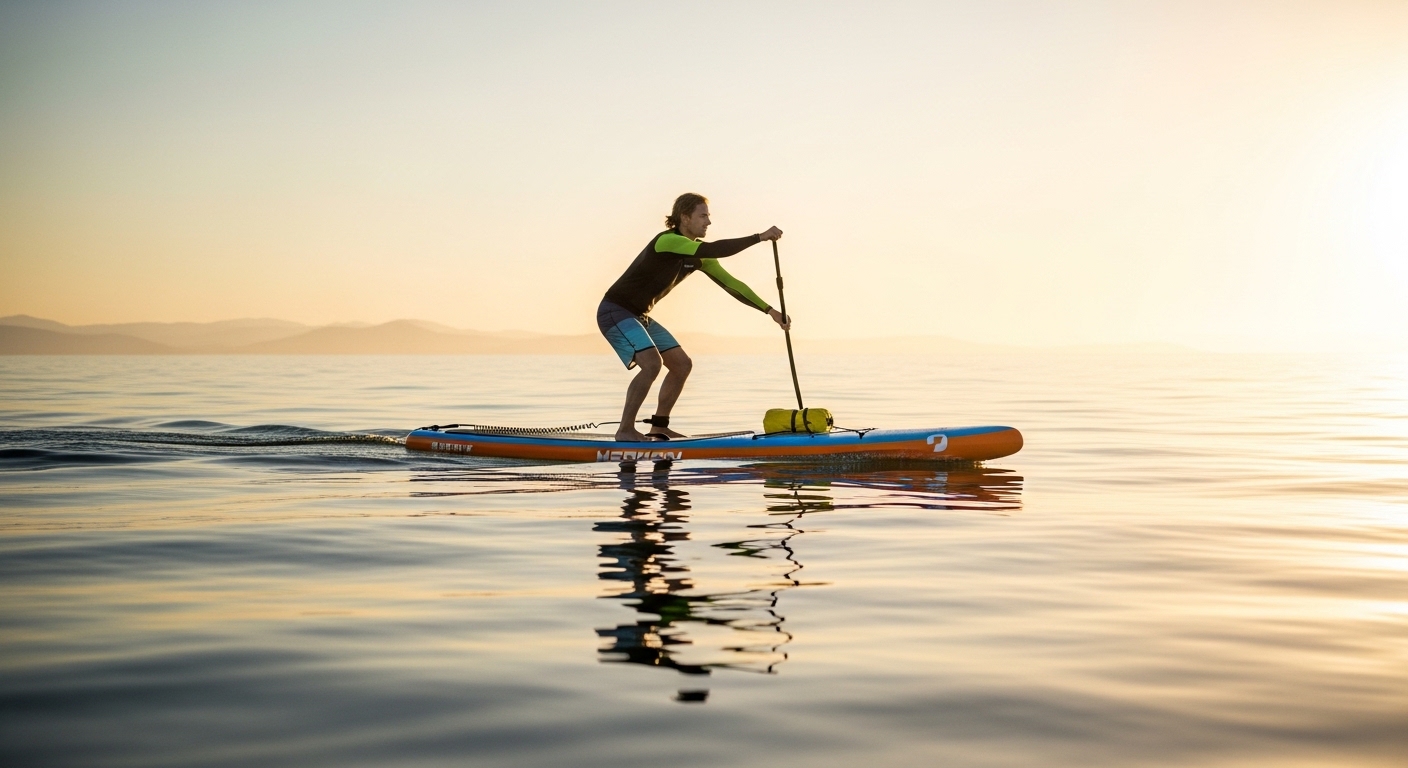
5 Simple Steps To Master Stand-up Paddleboarding
Five clear steps take you from wobbly first-timer to confident paddler — no experience required.
Stand-up paddleboarding looks effortless when someone else is doing it. Then you climb on the board for the first time and realize balance, stroke, and steering are each their own skill. The good news: each one is learnable, and they build on each other in a logical order. This guide walks you through exactly how to master stand up paddle boarding — step by step, without the guesswork.
Step 1: Set Up and Launch Right
Most beginners skip the setup phase and pay for it the moment they hit the water. A few minutes on land saves a lot of splashing.
Choose the Right Board Size
Before anything else, make sure you are on a board sized for your weight and skill level. Beginners need volume — a wider, thicker board (at least 32 inches wide for most adults) gives you the stable platform you need to focus on technique instead of survival. Check out our guide to the best paddle boards if you are still choosing your equipment.
Adjust Your Paddle Before You Launch
Set paddle length so the handle sits at your wrist when you raise your arm straight overhead. Too short and you will hunch; too long and your stroke loses power. Most adjustable paddles have a simple clamp — set it on shore, not in the water.
Enter the Water the Smart Way
Walk the board into knee-deep water before you try to stand. Deep water entry near shore almost always ends in a fall. Place the board perpendicular to any waves or current, kneel on the center of the deck pad, and stabilize yourself before attempting to stand. If you are brand new, read our full breakdown of how to paddleboard for the complete launch sequence.
Step 2: Find Your Stance and Balance
Balance is not a natural gift. It is a skill, and it starts with understanding where and how to stand.
Find the Center of the Board
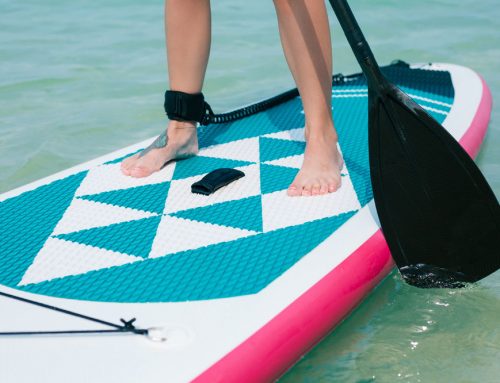
The carry handle is almost always positioned at the exact center of the board. That is your target standing position. Stand with your feet on either side of the handle, shoulder-width apart, toes pointing forward — not angled out like a surfer’s stance. Angled feet shift your weight unevenly and make balancing harder, not easier.
Bend Your Knees, Not Your Back
Soft, slightly bent knees are your shock absorber. Keep your back straight and your core lightly engaged. Most beginners lock their knees and bend at the waist when they feel unstable — this actually makes wobble worse. Flex your knees and let your hips absorb small movements in the board.
Keep Your Eyes Up
Looking down at your feet is instinct when you feel unsteady. Fight it. Fix your gaze on the horizon or a fixed point on shore. Your body’s balance system works dramatically better when your eyes are level with the horizon. This one change alone will improve your stability within minutes.
For a detailed breakdown of the transition from kneeling to standing, see our guide on how to stand up on a paddle board.
Step 3: Master the Forward Stroke
The forward stroke is the engine of paddleboarding. A clean stroke does two things at once: it moves you forward efficiently and keeps the board tracking straight. A sloppy stroke does neither.
Grip the Paddle Correctly
One hand goes on the T-grip handle at the top, the other on the shaft roughly halfway down. The blade should angle away from you — the angled face pushes water backward (toward the tail), not downward. Many beginners hold the paddle backward, which kills power and causes fatigue.
Drive from Your Core, Not Your Arms
Reach the blade forward, fully submerge it, then rotate your torso to pull it back through the water to your ankle. Your top hand pushes down and forward while your bottom hand acts as a pivot point. Arms alone tire quickly; your core is where real paddle power lives. Think of it as a rotation, not a pull.
Switch Sides Consistently
A forward stroke naturally pushes the nose in the opposite direction of your paddle side. To keep a straight line, switch sides every three to five strokes. Call out “switch” in your head and develop a rhythm. Inconsistent switching is one of the most common beginner mistakes and results in zigzagging across the water.
Step 4: Learn to Turn and Steer
Going straight is satisfying. Going where you actually want to go is better. Turning a SUP board takes a bit more intention than a kayak or canoe, but the techniques are straightforward once you understand the mechanics.
The Sweep Stroke
The sweep stroke is your primary turning tool. Instead of pulling the blade straight back, arc it away from the board in a wide C-shape from nose to tail. This leverages the full length of the board to pivot the nose. Sweep on the right to turn left; sweep on the left to turn right. Multiple sweeps in a row spin you around quickly even from a standstill.
The Reverse Stroke
Place the blade in the water at your hip and push it forward toward the nose. This acts as a brake and a turning aid. Combine a reverse stroke on one side with a forward stroke on the other for a quick pivot — useful in tight spots or when conditions catch you off guard.
Step Back to Pivot
For sharper turns, slide one foot back toward the tail to sink it slightly. The nose lifts and the board pivots more easily. This “pivot turn” is the go-to move for intermediate paddlers. Start practicing it in calm water so it becomes automatic before you need it in a current or around obstacles.
Step 5: Progress to Varied Conditions and Build Real Confidence
Flat-water skills are the foundation. Real paddleboarding confidence comes from gradually introducing yourself to wind, chop, currents, and new environments — on your own terms, at a controlled pace.
Introduce Wind Gradually
Start your paddle sessions going into the wind and return with it at your back. That way, if you tire out or conditions pick up, you are not fighting to get home. Light wind (under 10 mph) is a great training partner for improving your balance and stroke consistency without overwhelming you.
Practice Falling and Recovering
Falling is part of paddleboarding — even for experienced paddlers. Deliberately fall off in controlled conditions so the experience stops feeling like a crisis. Aim to fall away from the board to avoid hitting it. Climb back on from the side at the center, kicking your legs to generate momentum, and pull yourself up in one smooth motion.
Build Consistency Over Distance
Short, frequent sessions beat occasional long ones for skill development. Even twenty minutes three times a week will advance your technique faster than a single two-hour session once a month. Track your sessions loosely — distance, conditions, what felt difficult — and you will see measurable improvement over weeks, not months.
Try New Environments Deliberately
Once flat water feels routine, try mild river currents, a bay with light chop, or an ocean cove on a calm morning. Each new environment teaches you something flat water cannot — reading water movement, adjusting your stance dynamically, and making quick decisions with your paddle. Progress one variable at a time: new water type or new weather, not both at once.
Putting It All Together: Your Progression Path
Mastering stand-up paddleboarding is not about a single breakthrough moment. It is a series of small skills that compound. Here is how a realistic progression looks for most paddlers:
- Sessions 1–3: Stable stance, basic forward stroke, comfortable launching and landing.
- Sessions 4–8: Consistent straight-line tracking, reliable turns, first full sweating paddle session.
- Sessions 9–15: Adapting to light wind and small chop, pivot turns, longer distances without fatigue.
- Sessions 15+: Reading conditions, varied environments, confident recovery from falls, starting to refine stroke efficiency.
Everyone moves through these stages at a different pace — and that is fine. The paddlers who improve fastest are the ones who stay curious, paddle regularly, and do not let a bad session define their trajectory. If a session feels hard, it usually means conditions were tougher or you were working on something that challenges you. That is exactly when growth happens.
Come back to the fundamentals often. A session focused purely on stroke technique or stance adjustments is never wasted time — even experienced paddlers do it. The basics never stop mattering.